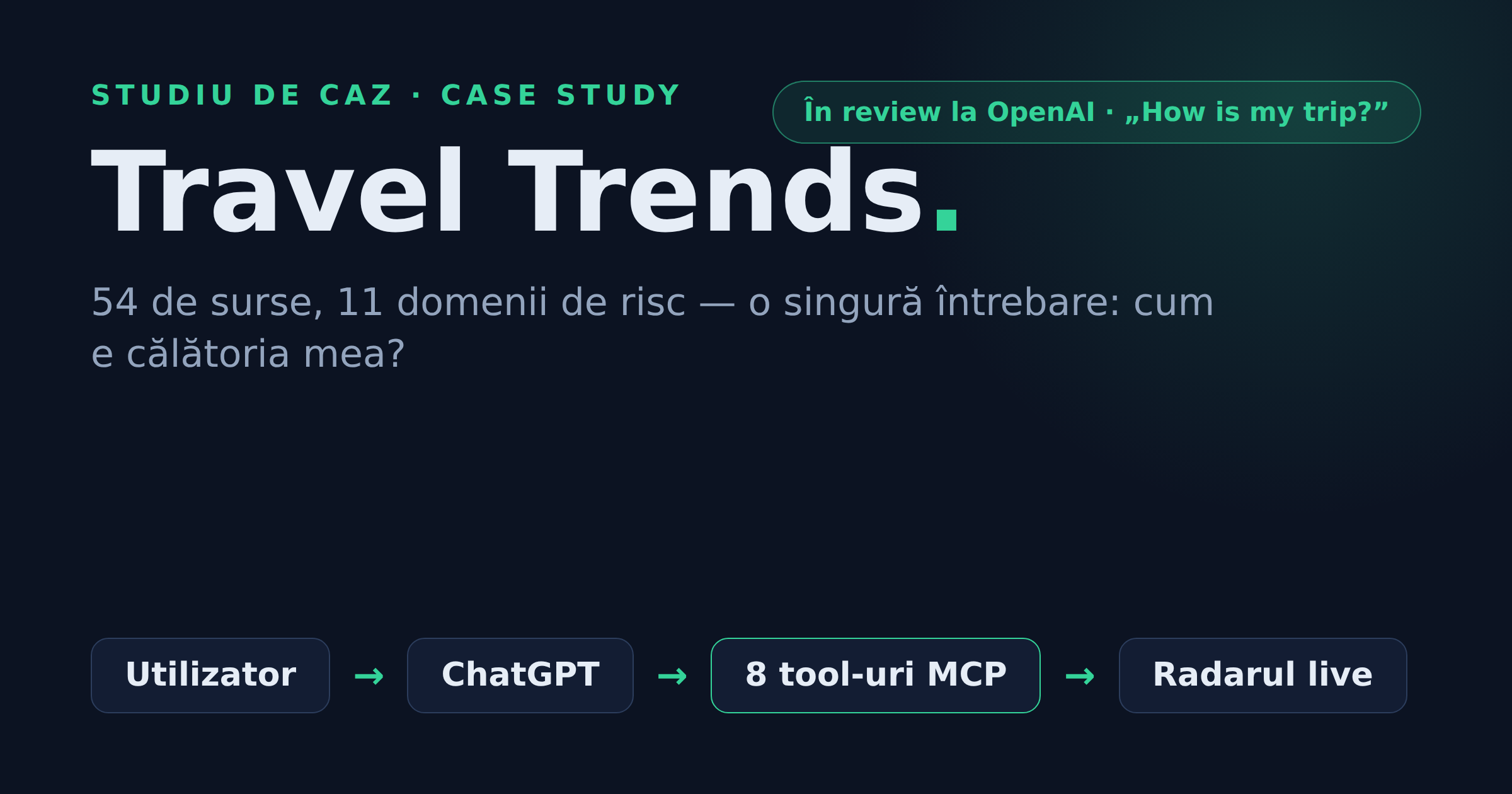
The last technical case study in the series about the four applications built for the OpenAI ecosystem — and the one written with the most deliberate restraint. Când Reciclăm is open source and its study goes deep into the architecture; Travel Trends is built as a professional platform, so here we talk about what it does and which decisions make it trustworthy — not how it's built inside. It remains, however, the most ambitious orchestration exercise in the series: dozens of permanently changing sources, melted into a single judgment.
At a glance
- 8 public MCP tools — from assessing a trip to persistent monitoring and "why haven't I heard anything?"
- 54 implemented sources (from a transparent catalog of 64), across 11 domains: aviation, rail, road, maritime, weather, health, geopolitical, public order, volcanic, disasters, borders
- All 27 EU countries covered with tourism data — 3.09 billion nights analyzed
- Answers with a visual card in clients that support MCP-Apps interfaces
- Published in the ChatGPT catalog on September 11, 2026 as "How is my trip?" — submitted to the OpenAI review on July 17, 2026
The problem
Before a trip in Europe, the information that matters exists — but it's scattered across dozens of places: strikes in local press, rail delays on operator websites, weather warnings at national services, geopolitical context in official alerts, public health in European reports. Nobody tracks them in one place. The traveler (or the agency managing hundreds of travelers) usually finds out late — or not at all.
Why existing solutions weren't enough
Airline alerts cover only the flight — we started from the complementary principle: the rest of the trip. News aggregators can't tell signal from noise and don't answer the concrete question: "does this affect me, on my route, in my dates?". And an AI model asked directly about next week's conditions will answer from its training data — that is, from the past. For travel decisions, stale information isn't just useless: it's dangerous.
Objectives
- One question, one judgment: "how is my trip?" — not 11 data feeds to scan manually.
- Watch, not just answer: a trip is something you follow; what changed since yesterday matters more than what was true a week ago.
- Verifiable honesty: "nothing happened" must be information too — not an ambiguous silence.
- The same data for humans and agents: a website for exploring, MCP for any AI assistant.
The architecture
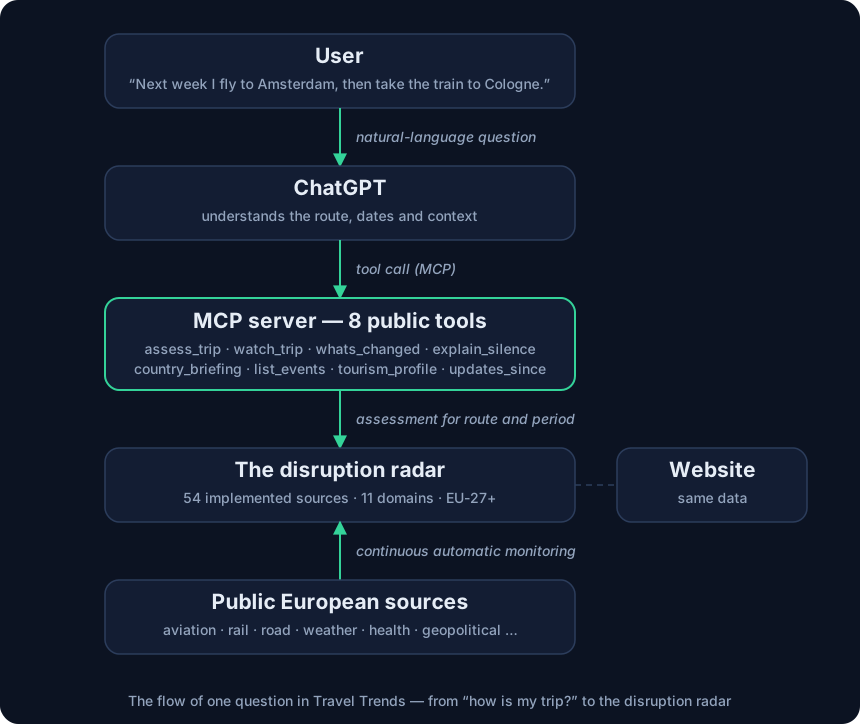
At the level we can talk about it, the architecture has three conceptual layers:
- The disruption radar: continuous automatic monitoring of public European sources — aviation, rail, road, maritime, weather, public health, geopolitical, public order, volcanic activity, disasters, borders. The source catalog is public, on the site: which sources exist, which are implemented (54 of 64) — honesty about coverage is part of the product.
- The judgment layer: normalized events become assessments — for a specific route, period and context. Not "here are 200 news items", but "here is what affects you, and how seriously".
- The agentic layer: the public MCP server with 8 tools, through which any compatible assistant can assess a trip, put it under watch and ask what changed — with answers that, in modern clients, appear as a visual assessment card, not raw text.
Why MCP and not a classic chatbot?
The series' answer still holds — the application goes where users already are — but Travel Trends adds the critical dimension of recency: here there is no correct answer from memory. A model without tools will describe Europe from its training data; with Travel Trends' tools, it answers from the radar of right now. And the difference between "I think it's fine" and "I checked 11 risk domains a few hours ago and it's fine" is exactly the difference a professional pays for.
The complete flow
User
    │  "Next week I fly to Amsterdam, then take the train to Cologne. Anything I should know?"
    ▼
ChatGPT
    │  understands the route, dates and context
    ▼
MCP server — 8 public tools
    │  assess_trip → assessment for the route and period
    ▼
The disruption radar
    │  54 implemented sources · 11 domains · EU-27+
    ▲
    │  continuous automatic monitoring
Public European sources
    (aviation · rail · road · weather · health · geopolitical …)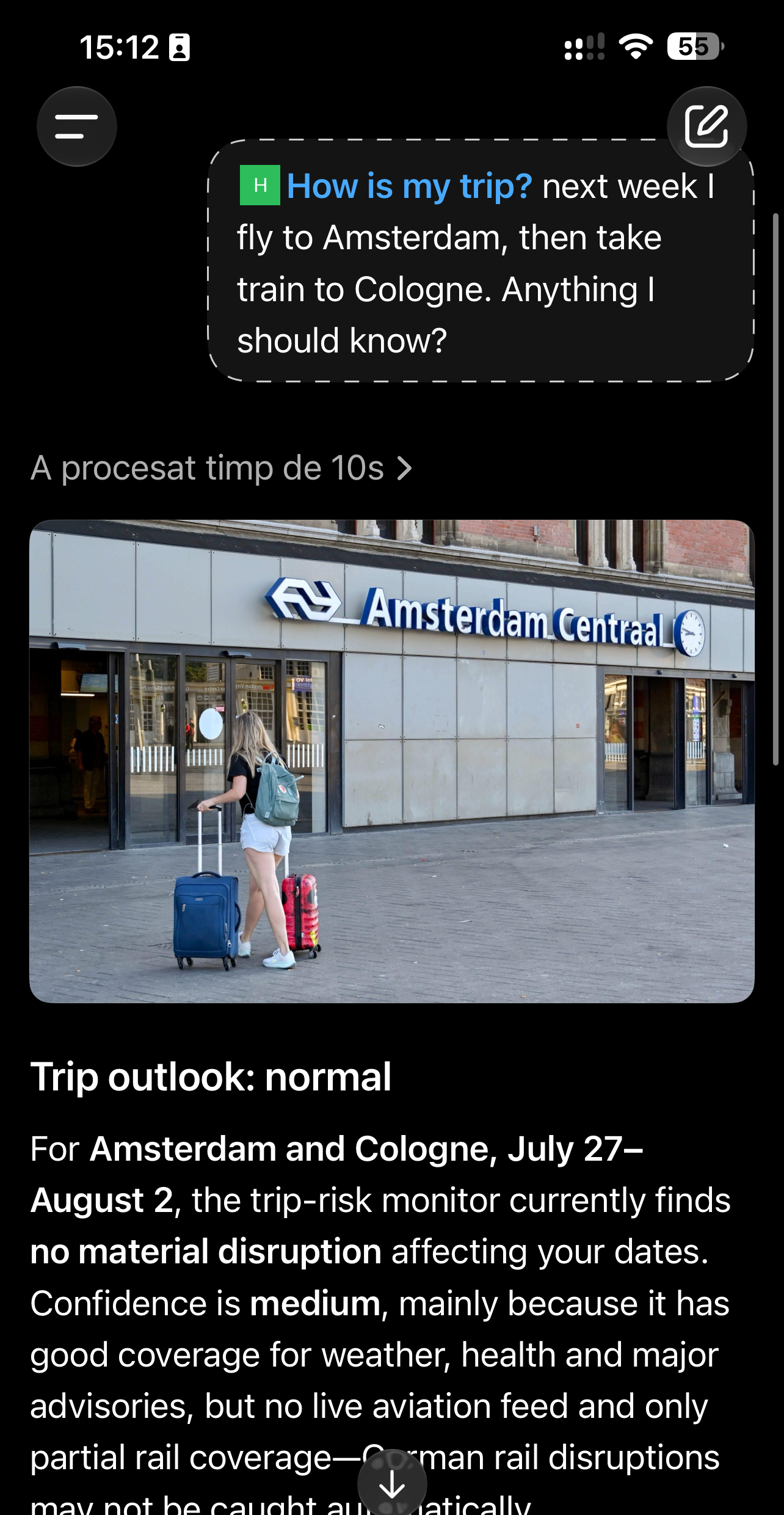
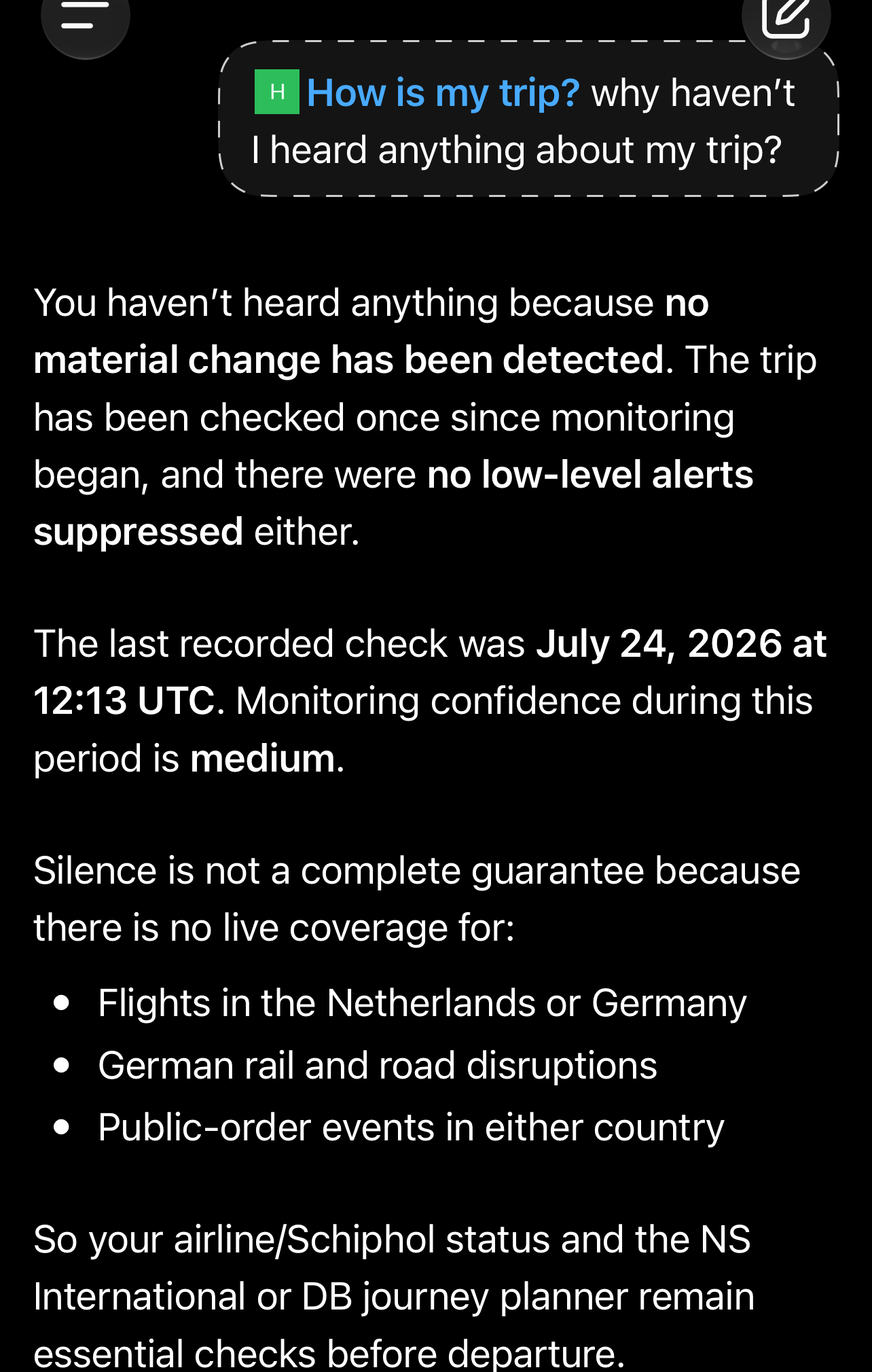
And after the assessment, the conversation doesn't end: watch_trip puts the trip under watch, whats_changed answers "did anything change since yesterday?", and explain_silence — my favorite tool in the entire series — answers "why haven't I heard anything?": I checked, there is nothing to report is fundamentally different information from I didn't check.
The challenges
- Source heterogeneity: 11 domains mean 11 different languages of risk — a rail delay, a volcanic alert and a public-health warning don't compare by themselves. Bringing them to a common scale of relevance is the invisible work behind every answer.
- Permanently changing data: the radar is not allowed to sleep — and the freshness of every answer must be verifiable, not assumed.
- Signal, not noise: for a traveler, only what intersects their route and dates matters. Filtering is harder than collecting.
- Trust in silence: the easiest client to lose is the one who stops receiving anything and doesn't know if that's good news. Hence explainable silence as a feature.
- The double audience: the individual traveler wants an answer; the professional managing hundreds of trips wants consistency, watching and history. The same tools serve both needs.
The key decisions
- Synthesis is the product, not aggregation — the value isn't that the data exists in one place, but that it becomes a single judgment on your route.
- The source catalog is public — including what is NOT yet implemented. Honesty about coverage before marketing promises.
- Monitoring as state, not as a request — a watched trip stays watched; the conversation can return to it anytime.
- Explainable silence — "nothing to report" is a first-class answer, with proof of the check.
- Complementary, not duplicative — we don't re-deliver the airline's notifications; we cover the rest of the trip.
- The same data for every surface — the website and the AI agents read the same radar.
The result
Travel Trends is live at travel-trends.mmatinca.eu: the disruption radar across 11 domains, tourism data for all 27 EU countries and the public MCP server with 8 tools — with the website available in English, Romanian and Polish. Built since March 2026 — the oldest application in the series after RoTV — it was submitted to the OpenAI review on July 17 and published in the ChatGPT catalog on September 11, 2026, under the name "How is my trip?". It is also the application where the series shows its deliberate limit: where the product has commercial ambitions, the case study stops at capabilities — and the rest remains competitive advantage.
What would I improve in the next version?
- Extended geographic coverage — beyond the EU-27, along clients' real travel corridors.
- More notification channels — a watched trip should reach you where you work, not only where you ask.
- Traveler-profile personalization — the same disruption weighs differently for a tourist and for a business traveler with a tight connection.
---
With this study, the series covers all four applications: Când Reciclăm, RoTV Guide, Digital Compass and Travel Trends. Next comes the synthesis piece: what I learned building four applications for an AI ecosystem. The context for the whole story: AI adoption is a delivery discipline.