The third case study in the series about the four applications built for the OpenAI ecosystem. Când Reciclăm was about honesty in data, RoTV Guide about orchestration and tool selection. Digital Compass is about something else: how you turn government procedures and scattered information into a conversational assistant that knows what to do now — and where each situation gets reported, in your country. A study about knowledge organization.
At a glance
- 5 public MCP tools — list of situations, full content, finding the right playbook, reporting channels, freshness
- 19 crisis playbooks + 11 prevention guides, in 9 languages — 270 synchronized documents
- Reporting channels per country — real localization, not just translation
- Installable PWA with guides savable offline — useful exactly when you need them
- Launched on July 10, 2026 — one day after the OpenAI app catalog opened; submitted to review on July 17, published in the catalog on August 14, 2026 · MCP server in the official registry
The problem
When something happens to someone online — a fake link, a hacked account, a shopping scam, blackmail — they find either talk about "digital skills" or technical articles. The real procedures are scattered across institutional websites, different from country to country, written for clerks, not for a person in panic. There is no clear public path, in their language, answering the only question that matters in that moment: "what do I do NOW?"
Why existing solutions weren't enough
Classic digital education prevents, but doesn't help in a crisis: nobody reads a phishing course on the evening their card got emptied. The reporting information exists, but fragmented: the police in one place, consumer protection in another, the platform in a third — and everything different in every country. For an AI model asked directly, the situation is even more dangerous: without a structured source, the model improvises procedures and phone numbers. In digital safety, an invented procedure is worse than none.
Objectives
- Situation → what to do now: crisis playbooks, not articles — the steps to take, in order, plus what NOT to do.
- Written for non-technical readers: for the moment of panic, not for specialists.
- Local, not generic: where you actually report, in your country — 9 countries, each with its own channels.
- Accessible anywhere: on the web, as a PWA with offline-savable guides and, through MCP, in any AI assistant.
The architecture
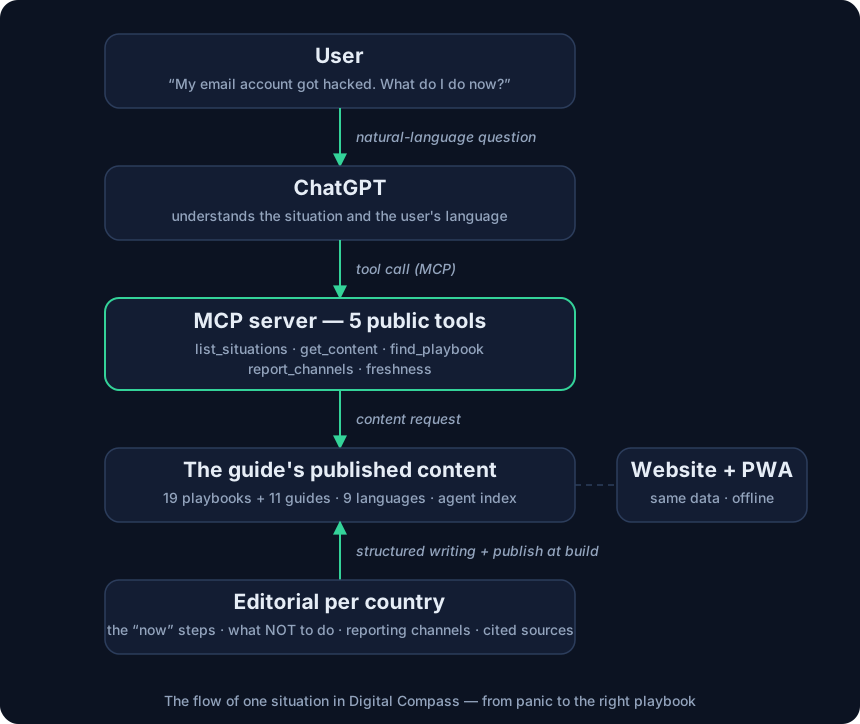
Here is the essential difference from the previous studies: Digital Compass has no external real-time data sources. The knowledge is the product — and the architecture is built around organizing it:
- The content: every situation is a playbook with the same structure — the "now" steps, what NOT to do, where to report, cited sources. Every prevention guide likewise. The common structure isn't aesthetics: it's what makes retrieval predictable.
- The static site: content is published through the build, in 9 languages, together with a dedicated agent index — a map of all situations and guides, with categories and audiences.
- The MCP server: reads exactly the site's published content — not a separate database. Five tools: the list of situations, the full content of a playbook, finding the right playbook for a freely described situation, the reporting channels and the content freshness.
The series' principle stays unchanged: the website, the PWA and the AI agents read the same knowledge. The website is the database.
Why MCP and not a classic chatbot?
For a digital-safety guide, the answer carries extra stakes. Questions arrive in moments of stress, and a model left on its own will answer fluently and convincingly — inventing steps, institutions and phone numbers. With MCP, the roles separate healthily: humans write and verify the procedures, the machine serves them. The model does what it does best — understands the situation described in the user's panicked words and leads the conversation — while the delivered content is the editorially written and verified one, with cited sources. Anti-hallucination isn't a filter added at the end; it is the architecture itself.
The complete flow
User
    │  "My email account got hacked. What do I do now?"
    ▼
ChatGPT
    │  understands the situation and the user's language
    ▼
MCP server — 5 public tools
    │  compass_find_playbook → compass_get_content
    ▼
The guide's published content
    │  19 playbooks + 11 guides · 9 languages · agent index
    ▲
    │  structured writing + publish at build
Editorial per country
    (the "now" steps · what NOT to do · reporting channels · cited sources)
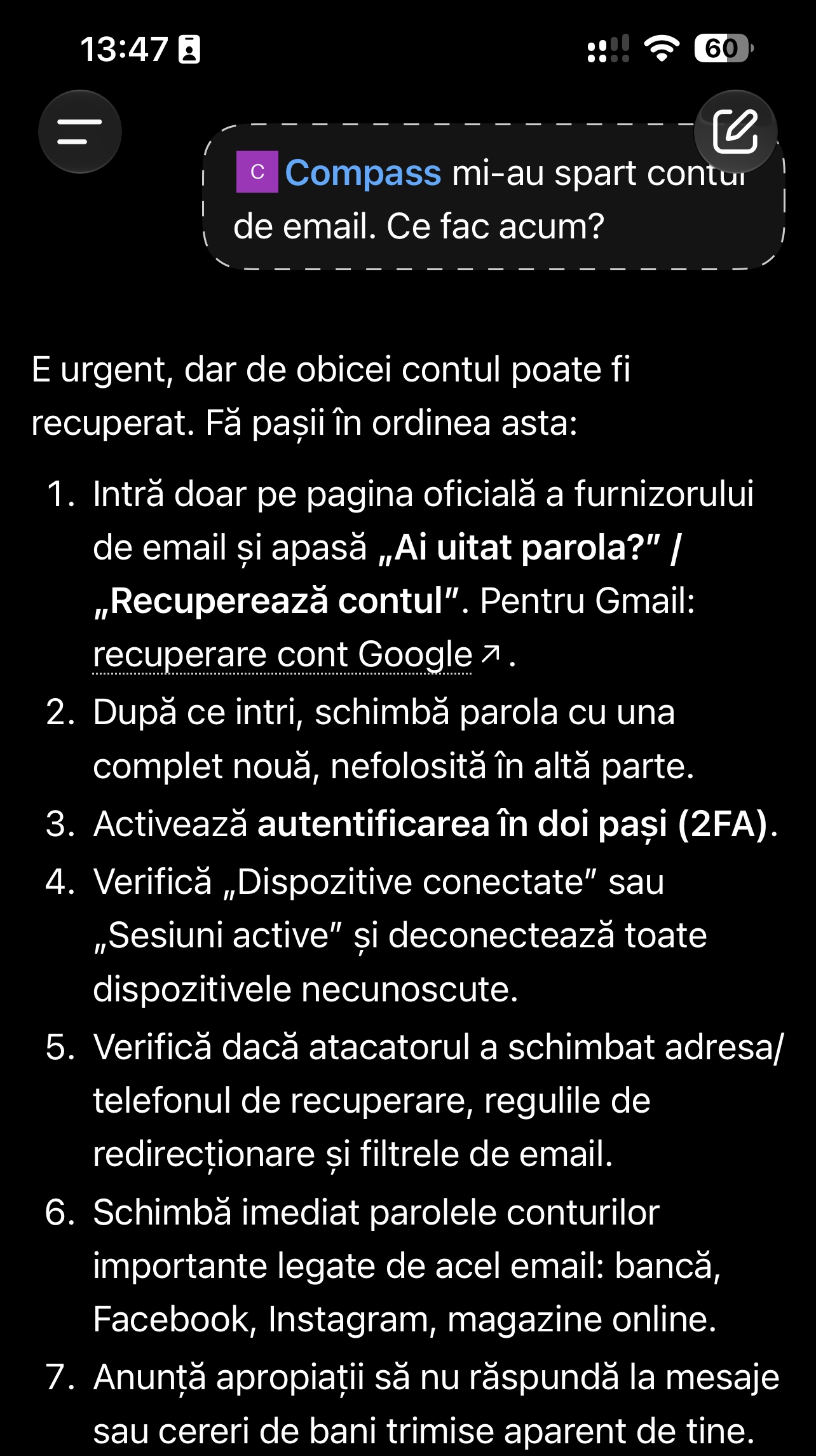
The user describes the situation in their own words. The model identifies the right playbook, requests the content in the user's language and delivers it conversationally — including where to report in their country. Where the client supports visual interfaces (MCP-Apps), the playbook appears as an interactive checklist, not a wall of text.
The challenges
- Knowledge organization: government procedures and scattered information had to be brought into a single playbook format. The project's central lesson: good retrieval starts at writing time, not at search time — a model finds the right playbook only if the knowledge was organized for retrieval.
- 270 synchronized documents: 30 pieces × 9 languages. The common structure makes synchronization verifiable — any missing or out-of-sync piece is detectable mechanically, not by re-reading.
- Real localization: translation is the easy part; the hard part is that every country reports differently. Reporting channels are editorialized per country, with a dedicated tool.
- Finding the playbook from vague descriptions: a person in panic doesn't say "phishing", they say "I clicked a link and now...". The situation-finding tool plus the category and audience filters exist exactly for the distance between the user's language and the content's taxonomy.
- Actionable in chat: a crisis playbook needs checkable steps, not prose — hence the MCP-Apps visual checklist.
The key technical decisions
- The website is the database — the MCP server reads the published build, not a copy; zero divergence between what humans see and what agents read.
- The playbook format as a contract — the same structure across all 270 documents; the predictability of the structure is what makes the tools useful.
- Localization as a first-class requirement — 9 countries with their own reporting channels, not one generic "international" version.
- Human-written content, machine-served — in the safety domain, cited sources and editorial verification are non-negotiable.
- Offline-first where it matters — a PWA with savable guides: in digital crises, access itself can be the problem.
- Read-only, no account — the guide helps; it asks for nothing.
The result
Digital Compass has been live since July 10, 2026 — one day after the OpenAI app catalog opened — at compass.madeinro.eu: 19 crisis playbooks and 11 prevention guides, in 9 languages, with each country's reporting channels and sources cited in the open. The MCP server is public, listed in the official registry, and on July 17 — one week after launch — the application was submitted to the OpenAI review for the ChatGPT catalog; on August 14, 2026 it passed review and is published in the catalog. The youngest application in the series is also proof that the template works: built from scratch directly on the architecture standardized across the other three.
What would I improve in the next version?
- More countries: the per-country editorial model is replicable — every new language means, first of all, new, verified reporting channels.
- Periodic channel verification: institutions' links and procedures change; checking them deserves automation, with a human editorial response.
- Visual checklists everywhere: extending the MCP-Apps cards as clients support them.
- The feedback loop: users who have been through a situation know what's missing from the playbook — their path back into the content deserves shortening.
---
This case study is part of a series on building AI applications for the OpenAI ecosystem. Previous episodes: Când Reciclăm and RoTV Guide. Coming up: Travel Trends. The context for the whole story: AI adoption is a delivery discipline.