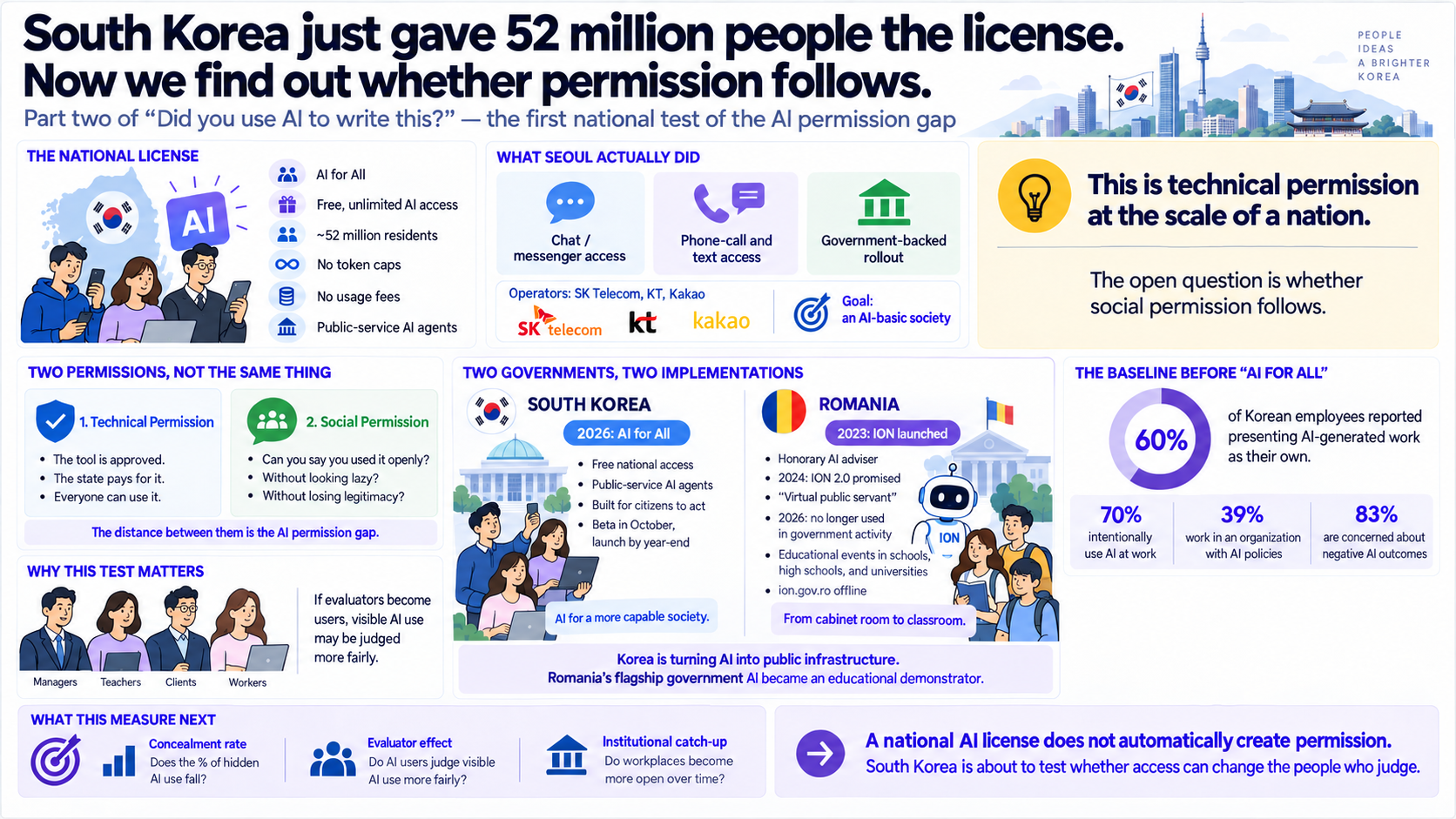
Part two of "Did you use AI to write this?" — the first national test of the AI permission gap
TL;DR. In July 2026 South Korea's Ministry of Science and ICT launched "AI for All": free, unlimited access to a general-purpose AI chatbot and a public-service AI agent for the country's roughly 52 million residents, built by three consortia and paid for by the state through at least 2028. Read through part one, that is technical permission at the scale of a nation. Part one's evidence says access alone is half the job: the social penalty for visible AI use moves only when the people who evaluate use the tool themselves. Korea enters as one of the most AI-saturated populations on earth, and still 60% of its employees reported presenting AI-generated work as their own, while its work culture moralizes visible effort more than any sample studied. Romania ran the other experiment: ION, a donated robot unveiled as a world first and, as the government confirmed on 22 September 2026, retired without announcement. Three indicators — concealment, the evaluator effect, institutions catching up with people — will say whether a license can grow into permission.
The AI permission gap is the distance between the technical permission to use AI — a license, an approved tool, paid for by the company — and the social permission to say openly that you used it, without paying a price in status.
Part one ended on a question nobody in charge of a national AI strategy was asking. In Romania, individuals use generative AI at more than three times the rate of the companies they work for. How much of that distance is missing capability — and how much is missing permission?
One country has just answered with the largest grant of technical permission in history. It did not answer the question. It made it testable.
What did Seoul actually do?
In July 2026, South Korea's Ministry of Science and ICT launched a program called "AI for All": free, unlimited access to a general-purpose AI chatbot and a public-service AI agent for all of the country's roughly 52 million residents, with no token caps and no usage fees. A competitive bidding process ran from 13 July to 11 August; on 28 August the ministry selected three consortia out of six bidders — led by SK Telecom, KT, and Kakao — to build and operate the service. The government is supplying them with 512 Nvidia B200 GPUs this year and will cover the cost of nationwide service from the national budget from 2027, with the service to stay free through at least 2028. At least half of the models behind it must be domestic Korean models that meet the ministry's sovereign-AI standards.
The stated purpose is not a chatbot. The ministry frames it as building an "AI-basic society," in which people can use AI regardless of income, age, or digital literacy. The minister, Bae Kyung-hoon, has called it "the calculator and computer of the AI era." And the agents are meant to do things, not just answer: make reservations and payments, find government assistance, complete administrative procedures — through mobile messengers, phone calls, and text messages.
The three operators laid out their plans at a ministry briefing on 4 September. Kakao's consortium uses KakaoTalk — the app that functions as infrastructure in Korean daily life — as the entry point to specialized agents for medical, financial, tax, education, employment, and care services, and targets 5 million monthly active users by December. KT is bundling a general-purpose agent with public-affairs, education, finance, and shopping services. SK Telecom is building an agent reachable by app, phone call, or text message — explicitly for people who struggle with apps — that can carry out identification, applications, and purchases, and that it plans to connect to Government24 and PASS so users can request 83 types of official certificates.
Betas are due in October — KT held its consortium launch on 21 September — with official launch before the end of the year. The government has not set an adoption target.
All of this sits on an AI budget of about 10 trillion won (roughly $7.2 billion) for 2026, three times the previous year's allocation. No national government has previously treated access to advanced AI models as a public utility at this scale.
Why is this the permission gap's first national experiment?
Recall the distinction that part one was built on. Technical permission is the license: the tool is approved, paid for, available. Social permission is the ability to use it visibly without paying a price in status — without being read as lazier, less competent, less legitimate. An organization can be at 100% on the first and near zero on the second; the distance between them is the permission gap.
Read through that lens, "AI for All" is technical permission at the scale of a nation. A license for every resident, paid for by the state, with the state's name on it.
And part one's evidence says that, on its own, this is half the job. The research it rests on found that messaging alone does not close the gap — describing AI use as common rather than rare changed the social penalty not at all — and that policies alone do not either. The single moderator that consistently moved the penalty was the evaluator's own hands-on experience: in the PNAS experiments, evaluators who did not use AI penalized AI users, and evaluators who did use AI rated them more favorably. The penalty lives in the evaluator, not the evaluated.
Which is exactly what makes Korea interesting. A national program cannot decree social permission. But it can, by accident or design, saturate the one condition the research says produces it: it turns every evaluator into a user. Every manager, every teacher, every client, every board member gets the same free, unlimited tool as the person they are judging. If the mechanism in part one is right, South Korea should be the place where the social penalty for visible AI use collapses fastest.
If it does not collapse, that is a finding too. It would mean the gap is cultural rather than infrastructural — and there is a specific reason to take that possibility seriously in Korea, of all places.
The baseline nobody is reading
The study that opens part one — KPMG with the University of Melbourne, 48,000 people across 47 countries — also published a country snapshot for Korea, with data collected in late 2024 and early 2025, well before "AI for All" existed. It is the closest thing we have to a "before" picture.
Koreans expect a great deal from AI: 89% expect it to deliver a range of benefits, 75% accept or approve of it, 84% report improved efficiency from using it. Trust is another matter: 44% are willing to trust AI, 83% are concerned about negative outcomes, and 63% report having experienced AI-driven misinformation. And at work, the same pattern as everywhere else — arguably sharper. Seven in ten Korean employees say they intentionally use AI at work, and 60% reported presenting AI-generated content as their own, against 57% globally. Two-thirds relied on AI output without checking its accuracy; 54% worry about being left behind if they don't use AI; and only 39% work in an organization with policies governing responsible use. The pressure to use is high. The permission to say so is not.
Sit with that number for a moment. South Korea entered this program as one of the most AI-saturated populations on earth. Reporting that cites government surveys puts the share of Koreans paying for private AI tools at around 25%, against roughly 2% of American consumers, with more than 20 million already using free services. This is a country where technical adoption ran far ahead of the rest of the world — and where employees hid their use at least as much as the global average.
That is part one's thesis, confirmed in the hardest possible place. Access did not produce permission. Not even at Korean levels of access.
There is a second reason to expect the Korean case to be hard, and part one already contains it. The moralization-of-effort studies — the research showing that people judge visible effort as morally superior even when it improves nothing — were run in the United States, France, and South Korea. In the Korean sample the effect was the largest of the three: the harder-working of two equally productive workers was judged more moral (d = 0.71, against 0.60 in the US and 0.38 in France) — and, at the same time, less competent. Visible effort bought virtue, not competence, and nowhere more expensively than in Korea. Korean work culture is famously built around visible effort. The country now handing every resident a free, state-funded license in the expectation that access will normalize AI is the same country in which the psychology says efficiency reads as cheating.
So the experiment has real stakes on both sides. If universal access flips the evaluators, the gap closes despite the culture. If the culture holds, the gap survives the access.
The second penalty goes public
Part one described a second, quieter penalty: the AI itself signaling distrust of its user. "If your card is indeed issued in the UK…" instead of "I can't verify the issuer." The system's verification limit, dressed up as doubt about the person.
"AI for All" moves that problem into the public sphere. The agents being built are meant to help people request official certificates, apply for government assistance, deal with taxes, book medical appointments. When a state-provided agent tells a citizen "if your income is indeed below the threshold…", the distrust is no longer a product's tone. It is the state's.
That makes part one's design principle a public-service requirement. A public AI agent must distinguish between what it cannot verify and what it has reason to doubt; must state its limits in a layer of its own rather than in the voice a citizen is asked to collaborate with; must accept citizen-provided facts as the working premise absent a contradiction; and must not reintroduce a correction later as an "if." This is not politeness. In a country where 68% already say they are unsure whether online content can be trusted, a public agent that reflexively hedges its own citizens will teach 52 million people that the state's AI does not believe them.
The trust deficit runs both ways, and the program will have to close both. Citizens are being asked to trust a state-provided model with their tax situations and medical bookings. The model has to be built to trust them back.
Two governments, two theories of the gap
Korea is not choosing distribution instead of regulation. Its AI Basic Act took effect on 22 January 2026 — the world's second comprehensive AI law after the EU's — and, like Article 50 of the EU AI Act, it requires operators to tell users when AI is being used and to label generative outputs that could be mistaken for human work. The difference is in the weight, and in what sits next to the obligation. Korean fines top out at 30 million won, about $21,000, and the ministry is operating a grace period of at least a year before imposing them; the EU's Article 50 penalties reach €15 million or 3% of global turnover. And Korea has paired its disclosure duty with a national access program. The EU has paired its own with nothing of the kind.
So two theories of the gap are now running in parallel. Europe's says: mandate the transparency, sanction the failure, and let the market and the workplace sort out the social cost. Korea's says: mandate the transparency lightly, and dissolve the social cost by making the tool as ordinary as electricity.
Part one showed that the European combination has a structural problem: the law now requires exactly what the market penalizes. Mandatory transparency, penalized transparency, and nobody in charge of the space between. Korea's bet is that if everyone has the tool, the penalty for admitting you used it has nowhere left to live. Whether that is true is not a matter of opinion. It is a matter of the next survey wave.
Romania already ran the other experiment
Romania is not absent from this story. It ran the other version of it.
On 1 March 2023, the Romanian government presented ION at a cabinet meeting — described as the world's first government advisor based on artificial intelligence: a physical robot, given the title of "honorary advisor" to the prime minister, whose stated job was to collect and synthesize the opinions and grievances of Romanians for the administration. It was built pro bono by a private team and offered to the state at no cost. A month in, the Ministry of Research reported 750,000 messages and social-media tags and more than 2.5 million website visits.
Then it went quiet. After the change of prime minister in mid-2023, the robot stopped appearing at cabinet meetings. In October 2024 the Ministry of Digitalization told HotNews the project had not been abandoned: ION 2.0 was in the works, a "virtual public servant" connected to the catalogue of public services, able to answer citizens' questions about passports, identity cards, and other procedures. That version never launched. By January 2026, the ION website no longer responded. And on 22 September 2026, in a written answer to the newspaper Libertatea, the Prime Minister's Chancellery confirmed the state of things: the physical robot is no longer at the Victoria Palace and is no longer used in the government's activity in the form in which it was presented; it is kept by the research team that built it and appears at educational events in schools, high schools, and universities; the software sits on a virtual machine hosted by the National Research Authority; ion.gov.ro does not work. The government did not say when the use stopped.
None of this is a scandal. It is a pattern — and it spans successive governments led by both major parties, which is exactly why it should be read as an institutional fact rather than a political one.
Put the two national stories side by side. Korea's public agent is designed to act with the state on a citizen's behalf — 83 kinds of official certificates through Government24 and PASS, appointments, applications, payments — built by three telecom and platform companies on a budget line through 2030, with a panel of citizens and experts giving feedback during the beta. ION was designed to listen: a channel for opinions, collected and synthesized upward. Korea treats AI as a service the state delivers. ION was AI as a gesture the state performed. The asymmetry deserves to be said out loud, because it is the point rather than a caveat: this is not a contrast in execution between two funded programs. One state budgeted a service through 2030. The other accepted a donated prop at no cost — and never funded the version that would have done something.
The gesture has a cost in exactly the currency this article is about. Part one's playbook rests on a single finding: the social penalty for visible AI use moves when the people who evaluate use the tool themselves, visibly, on real work. A state is the largest evaluator in a citizen's life. When its one visible act of "using AI" is a robot unveiled as a world first, retired without announcement, and rediscovered three years later touring high schools, the lesson it teaches is not that AI is the calculator and computer of the era. It is that AI in public life is a prop with a shelf life — something an institution poses with, not something it relies on. That is social permission moving in the wrong direction, from the top.
And the most telling detail is the one nobody planned. The ION 2.0 that Romania described in October 2024 — a virtual public servant, wired into the catalogue of public services, answering questions about passports and IDs — is, almost line for line, the public agent South Korea is putting into beta in October 2026. Romania described Korea's product two years earlier. What it delivered was an exhibit.
What would count as evidence?
This is where the piece has to be honest. There is no post-launch data yet; the betas begin in October. Anyone claiming today that "AI for All" has closed or failed to close the permission gap is guessing. What can be done today is to write down, in advance, what closing it would look like — so that the answer, when it arrives, is a measurement rather than a story.
Three indicators, in order of how directly they test the mechanism.
Concealment. The KPMG–Melbourne study runs in waves. Korea's pre-program baseline is 60% — the share of employees who reported presenting AI-generated work as their own. If universal access produces social permission through the evaluator channel, that number should fall in the next wave — and fall faster than the global figure. If it stays flat while usage rises, the gap is not an access problem.
The evaluator effect. The PNAS finding is that the penalty reverses among evaluators who use AI themselves. Korea offers a population in which nearly every evaluator will soon be a user. A hiring or evaluation experiment replicated in Korea after rollout, alongside a control country, would show whether the reversal scales when the whole population crosses the line at once.
Institutions catching up with people. In Romania, individuals use generative AI at three times the rate of their firms. Korea will have a state-run channel for individuals from December; the question is whether visible, openly declared use inside organizations rises with it, or whether the workplace remains the last place people hide.
The prediction, stated plainly so it can be wrong: the concealment number in Korea will fall, but not to zero and not quickly, because effort norms do not update on a licensing schedule — the fastest movement will be in evaluators' judgments, and the slowest in what people are willing to say out loud about how they work. If the next wave shows concealment unchanged, the evaluator mechanism is weaker than part one argued. If it collapses, part one's remedy — start with the people who judge — has just been validated at the scale of a country.
What this means for a country at the bottom of the table
The permission question is the one Europe should be watching, and Romania most of all. The EU has chosen to regulate disclosure first and leave access to the market. The result, in the EU's last-place country for enterprise AI adoption, is 5.21% of firms using AI while 17.8% of people do, a public-sector AI whose career ran from a cabinet meeting to classroom demonstrations, and an accusation — "did you use AI to write this?" — that still costs the person it is aimed at.
No European government is going to hand its population a national AI license by December. But the mechanism Korea is testing at national scale is available to any organization at organizational scale, for the price of a decision: give the tool to the people who evaluate before you measure the people who produce. Make their use visible. Retire the question that polices the method, and publish the questions that test the work.
South Korea is about to find out whether a license can grow into permission. The rest of us do not have to wait for the answer to run the same experiment on a smaller scale — and to start measuring the only adoption number that has ever mattered: can someone in your organization say "yes, I used AI for this" without the value of their work dropping in the room?
Sources
- Korea Herald (28 Aug 2026). SKT, KT, Kakao consortia selected for govt.-led AI service project. koreaherald.com
- MLex (28 Aug 2026). SK Telecom, Kakao, KT to lead South Korea's project to offer free AI-agent services. mlex.com
- Korea JoongAng Daily (Aug 2026). SK Telecom, Kakao and KT chosen for South Korea's public AI service project. koreajoongangdaily.com
- The Korea Times (4 Sept 2026). Korea to provide free AI agents for all citizens through messenger, texts. koreatimes.co.kr
- UPI / Yonhap (4 Sept 2026). S. Korean firms unveil plans for gov't-led AI project. upi.com
- The Asia Business Daily (4 Sept 2026). "Everyone's Free AI" to launch this year. asiae.co.kr
- TechNode Global (28 Aug 2026). South Korea picks trio for free national AI service. technode.global
- Digital Today (22 Sept 2026). KT steps up building "AI for All" ecosystem, uniting capabilities of 16 companies. digitaltoday.co.kr
- The Diplomat (Sept 2026). To succeed in AI, South Korea is reinventing its developmental state model. thediplomat.com
- Asia Times (16 Sept 2026). Why South Korea is giving 51 million people unlimited AI. asiatimes.com
- IBTimes KR (Sept 2026). South Korea launches "AI for All" initiative offering free nationwide access. kr.ibtimes.com
- TechSpot (Aug 2026). South Korea is giving its entire population free access to AI, no token limits. techspot.com
- Gillespie, N., Lockey, S., Ward, T., Macdade, A. & Hassed, G. (2025). Trust, attitudes and use of artificial intelligence: A global study 2025 — Korea insights. The University of Melbourne & KPMG. Korea snapshot (PDF) · global study
- Reif, J. A., Larrick, R. P. & Soll, J. B. (2025). Evidence of a social evaluation penalty for using AI. PNAS, 122(19). doi.org/10.1073/pnas.2426766122
- Celniker, J. B. et al. (2023). The moralization of effort. Journal of Experimental Psychology: General, 152(1). doi.org/10.1037/xge0001259
- Library of Congress, Global Legal Monitor (20 Feb 2026). South Korea: Comprehensive AI legal framework takes effect. loc.gov
- Cooley LLP (27 Jan 2026). South Korea's AI Basic Act: Overview and key takeaways. cooley.com
- Eurostat (2025). Use of artificial intelligence in enterprises and by individuals, 2025 reference year. enterprises · individuals
- Ministry of Research, Innovation and Digitalization, Romania (29 Mar 2023). One month after launch, ION received 750,000 messages and more than 2.5 million visits. mcid.gov.ro
- HotNews.ro (19 Oct 2024). ION left the government with Ciucă, but version 2.0 is in the works: "it will operate as a virtual public servant." hotnews.ro
- Wall-Street.ro (27 Jan 2026). How have the state's robots fared so far? ION, Antonia, Lazăr. wall-street.ro
- Libertatea (22 Sept 2026). Robotul ION, AI-ul lui Nicolae Ciucă, dat afară de la Guvern — with the written response of the Prime Minister's Chancellery. libertatea.ro · reproduced by Playtech and Money.ro
- Matinca, M. (31 Aug 2026). "Did you use AI to write this?" — the question quietly costing companies millions. mmatinca.eu