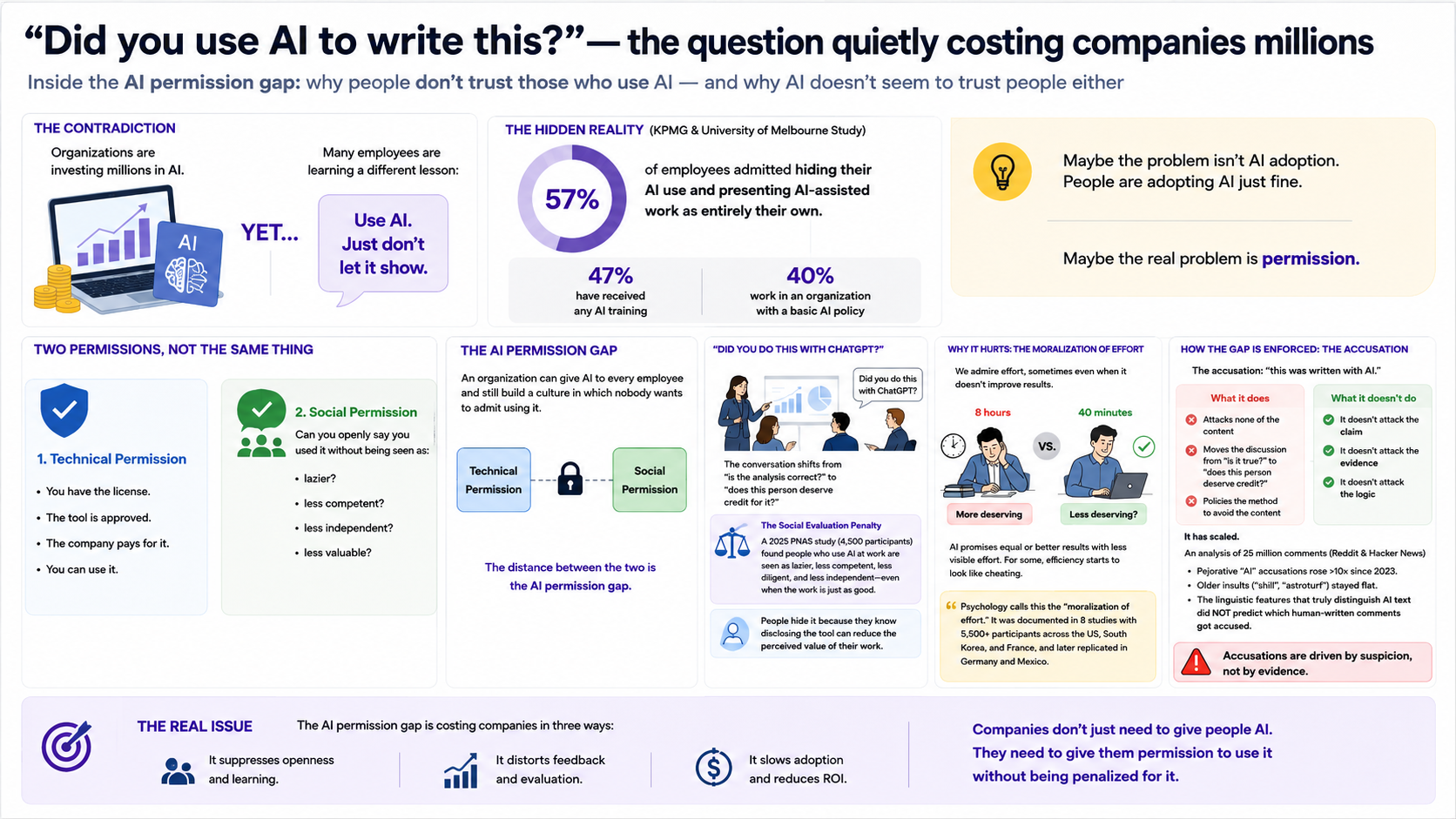
The AI permission gap — what happens when people don't trust those who use AI, and AI doesn't seem to trust them.
permission gap
The AI permission gap is the distance between the technical permission to use AI — a license, an approved tool, paid for by the company — and the social permission to say openly that you used it, without paying a price in status.
There is an interesting contradiction inside modern companies.
Organizations invest millions in artificial intelligence. They buy Microsoft Copilot licenses, approve ChatGPT Enterprise, launch adoption programs, run trainings, appoint internal champions, publish policies, and track carefully how many employees have access to AI tools.
And yet, inside those same organizations, many employees learn a completely different lesson:
Use AI. But make sure it doesn't show.
One of the largest global studies of employee behavior toward AI — KPMG together with the University of Melbourne, more than 48,000 people across 47 countries — found something hard to ignore: 57% of employees admitted that they hide their AI use and present AI-assisted work as entirely their own.
More than half. Worldwide. And this while only 47% had received any form of training, and only 40% work in an organization that has so much as an AI policy.
That raises an uncomfortable question. Maybe companies' problem is not AI adoption. Maybe people adopt AI very well. Maybe the real problem is permission.
Two permissions that are not the same thing: what is the AI permission gap?
The first is technical permission. You have a license. The tool is approved. The company pays for it. You can use it.
The second is social permission. Can you say openly that you used it without being seen as lazier? Less competent? Less independent? Less professionally valuable?
The two are not the same thing at all. An organization can hand AI to every employee and, at the same time, cultivate a culture in which nobody wants to admit they use it. The distance between the two is what we can call the AI permission gap.
Once you notice the phenomenon, many of the seemingly contradictory behaviors inside companies become easy to explain.
„Did you do this with ChatGPT?"
Picture a meeting. Someone presents a detailed analysis. The data is right, the arguments are solid, the recommendations make sense. The discussion goes well. Until someone asks:
„Did you do this with ChatGPT?"
From that moment, the conversation changes. Seconds earlier, the question was „is the analysis correct?" Now it becomes „does this person deserve credit for the analysis?" We are no longer evaluating the truth. We are evaluating the legitimacy of the author.
And research shows this penalty is real. A study published in PNAS in 2025 — four preregistered experiments, nearly 4,500 participants — identified what the authors call a „social evaluation penalty" for using AI. People who use AI at work are perceived as lazier, less competent, less diligent, and less independent. Even when the work output is just as good. In hiring experiments, evaluators who did not use AI themselves were less willing to hire people who said they used it frequently.
And people already seem to know this. That is why they hide their use. From the employee's point of view, the behavior is perfectly rational: if disclosing the tool lowers the perceived value of your work, why would you disclose it?
There is a deeper psychological explanation too. People associate effort with merit — psychology calls it the „moralization of effort". We admire the person who struggled, sometimes even when the extra effort improved the result not at all; the phenomenon was documented across eight studies, with more than 5,500 participants, in the US, South Korea, and France, and later replicated in Germany and Mexico. Someone who works eight hours on a document feels instinctively more deserving than someone who reaches the same result in forty minutes.
Artificial intelligence hits this intuition directly. It promises equal or better results with less visible effort. And for some people, efficiency starts to look like cheating.
How the gap is enforced: the accusation
The mechanism that keeps the permission gap in place is the accusation: „that's written with AI".
Notice what that sentence does — and what it does not. A real counterargument attacks the claim, the evidence, or the logic. The accusation attacks none of them. It moves the discussion from „is it true?" to „does this person deserve credit?" It polices the method to avoid the content.
And the mechanism has spread. An analysis of 25 million comments on Reddit and Hacker News found that pejorative „AI" accusations rose more than tenfold since 2023, while older invective — „shill", „astroturf" — stayed flat. The most telling result: the linguistic features that actually distinguish AI text do not predict which human-written comments end up accused. The accusation has decoupled from detection. It works as gatekeeping — it decides whose contribution counts — often delivered with full conviction as „written with chatgbt". Wrong name. Total certainty.
And the certainty is unearned. A study published in PNAS showed that people distinguish AI-written from human-written text at close to coin-flip level — and that the heuristics they rely on are flawed and can be exploited: AI text can be made to look „more human than human". For generated images, video, and audio, a 2025 paper in Communications of the ACM is titled, exactly, „As Good as a Coin Toss". Worse, the same „tells" — rich vocabulary, correct structure, tidy phrasing — fail systematically against non-native speakers: a study in Patterns showed that AI detectors labeled as „AI-generated" more than 60% of TOEFL essays written by humans. The tell is not forensic. It is an impression — and the impression has a nationality.
Blind delegation versus mature use
Here an important confusion arises. There is, of course, a bad way to use AI: you write a prompt, get an answer, copy-paste it, and send it. No verification, no judgment, no accountability. That is blind delegation — and the worries about it are real.
But mature use looks completely different. The human defines the problem and decides which question is worth asking. AI is used to attack the argument — weak points, contradictions, alternatives. Conclusions are tested in a fresh context, with no history. Important sources are verified. And in the end a human presses „send" and says, implicitly: „I stand behind this."
In such a process, AI does not remove the filters. It multiplies them. An analysis that „smells of AI" may be exactly the analysis that went through more scrutiny before publication, not less.
And verification is not a decorative step. Language models can produce plausible but false statements — hallucinations, a property of the generative mechanism, not a passing defect — and they can carry systematic biases inherited from the data and objectives they were trained on. These are two distinct phenomena with a single practical consequence: precisely because the tool can be convincingly wrong, verifying sources and human accountability are not optional. They are not a supplement to the method. They are the method.
And this is exactly where competence has to be redefined. The old model asks: „what can you produce entirely on your own?" The new model should ask: can you define the problem correctly? Can you steer the tool? Can you recognize a bad answer? Can you verify the sources? Can you explain the conclusion? Do you own the result?
Capacity can be amplified. Accountability cannot be outsourced.
None of this makes every objection illegitimate. „Did you put confidential data in the prompt?" „Does policy allow AI for this task?" „Did you check the result?" „Did you delegate a decision that should have stayed human?" — these are questions about process, where real lapses can occur, and they deserve direct answers. „You used AI", thrown at a correct analysis where no rule was broken, is something else: a procedural costume hung on an empty hanger.
The gap outside the wall
The problem does not stop inside the company. Customers react very similarly.
A field experiment published in Marketing Science followed more than 6,200 customers who received sales calls either from human agents or from AI chatbots. When people did not know they were talking to AI, the chatbots sold at the level of experienced human agents, and four times better than inexperienced ones. But when the AI identity was disclosed before the conversation, the purchase rate dropped by more than 79%.
Not because the tool had become weaker. Same system, same script, same performance. Only the label had changed: „this is AI". And with the label, customers perceived it as less competent and less empathetic — and bought less.
Other experiments confirm the pattern. Six studies of more than 1,000 adults showed that merely mentioning the phrase „artificial intelligence" in a product description lowers purchase intention, by reducing emotional trust — especially for products perceived as risky. And a series of 13 experiments with more than 3,000 participants — teachers, analysts, designers, investment funds — found that disclosing AI use consistently reduces trust in the person who declares it, through a single mechanism: perceived legitimacy. Softer framings do not save the situation: „AI only helped with proofreading" and „the result was reviewed by a human" still lost trust. The only thing worse than disclosing was being caught by a third party.
So the same pressure appears on both sides of the organizational wall. Inside, visible use costs reputation. Outside, declared use costs trust and, sometimes, revenue. And the system teaches both employees and companies the same strategy:
Use AI. But hide it.
The second penalty: what happens when AI doesn't seem to trust you?
Colleagues, then. Then customers. And there is one more dimension to this problem, far less discussed — the one that closes the circle: what happens when the AI itself starts sending you signals of distrust?
Picture the following situation. The user tells an AI system: „my Revolut card is issued in the UK." The AI answers: „if your Revolut is indeed issued in the UK…"
It looks like a minor difference in phrasing. Psychologically, it is not minor at all. The AI could have said „I can't verify your card's issuer" — a system limitation. Instead, it says „if what you say is true" — and the problem is no longer the AI's verification limit, but the user's credibility.
Here appears what we might call a double trust penalty. From the outside, society says: „you used AI, so your contribution is suspect." From inside the interaction, the AI can signal: „you are a user, so your information is suspect." And the person is left trapped between two systems of distrust.
Where does this come from? Largely, from guardrails. Many AI systems are built, rightly, to be cautious — especially in areas like fraud, identity, payments, security, or law. Caution is necessary. The problem appears when legitimate caution from one area leaks, uncalibrated, into the rest of the conversation and becomes a linguistic reflex. It is not a character flaw of any AI; it is a design artifact — normal and, precisely for that reason, correctable.
But the distinction matters enormously. „I can't verify that" is caution. „If what you say is really true" signals distrust. And if such phrasings appear consistently, the user may start to perceive the AI not as a collaborator, but as an interlocutor who must be convinced.
From here a chilling effect can emerge. The user offers less context, grows defensive, phrases messages strategically, avoids correcting the system, withholds information for fear it will be misread. With less context, the AI answers worse. Weaker answers produce even less trust. And a loop closes:
Social stigma → hidden use → weaker context → more errors → more suspicion → less trust → and, again, hidden use.
There is no place left where the user is not a suspect: not in the meeting room, not in front of the customer, not in the chat window.
There is also an important epistemic distinction here. An AI system should differentiate between „I can't verify what you say" and „I have reasons to doubt what you say." The first describes the system's limit. The second describes the person's credibility. A healthy principle for human–AI interaction might sound like this: absent a relevant contradiction, factual information offered by the user is accepted as a working premise; the system's verification limits are expressed separately; suspicion is justified, not automatic; and if the user corrects the system, the correction is not reintroduced later in the form of an „if".
Taken to its conclusion, the principle becomes a design direction: the system's limits and verifications belong in a layer of the interface of their own — visible and explicit — not slipped into the voice you collaborate with.
It may look like a phrasing problem. It is, in fact, a relationship problem. Because AI adoption does not depend only on the question „do people trust AI?" It may also depend on a question almost nobody asks: „do people feel that AI trusts them?"
The hypothesis could be tested simply. Two groups receive exactly the same AI answer; one sees „for your UK-issued card…", the other „if it's really UK-issued…". Then we measure: how much trust they still have in the system, whether they felt accused, whether they would continue the conversation, whether they would still offer context or information, whether they would still use the AI in the future. Maybe the difference would be near zero. But maybe not. And if it is not zero, then the companies building AI have an adoption problem they have not yet measured.
Why has „use it and hide it" just expired?
The problem is that this strategy — use it and hide it, from colleagues, from customers, even from the AI you work with — has just entered legally complicated territory. Since 2 August 2026, the transparency obligations of Article 50 of the AI Act have become applicable in the European Union. In the situations defined by Article 50, people must be told when they are interacting with an AI system, and providers must ensure AI-generated or manipulated content can be detected through machine-readable marking, while deployers face disclosure obligations for categories including deepfakes and certain public-interest text. Fines reach up to 15 million euros or 3% of global turnover. The European Commission adopted the enforcement guidelines in July; the only grace period — until 2 December 2026 — concerns the technical marking of systems already on the market.
The law drags into daylight precisely what everyone has learned to hide in order to survive socially.
In other words, an almost perfect contradiction emerges. Psychology says: „if you declare that you used AI, people may penalize you." Regulation says: „in certain cases, you must declare that you used AI."
This creates a completely new management problem: how do you operate between mandatory transparency and penalized transparency? It is a problem that sits at the intersection of adoption, governance, and human psychology — and in most organizations, nobody is sitting there.
How does the permission gap close?
Honestly, the research that diagnoses the gap is far more solid than the research that says how to close it. But the moderators are consistent from study to study and point in a single direction.
What does not work: the „everyone uses it" message — in the PNAS supplementary studies, describing AI use as rare or as frequent did not change the penalty at all. Softer disclosure framings — trust dropped anyway. Policies alone — 40% of organizations have them, and the hiding happens anyway.
What moves the needle: the direct experience of the one doing the judging. Inside, the PNAS penalty reverses among evaluators who use AI themselves — they rate AI users more favorably, not less. Outside, the chatbot experiment found that the disclosure hit is softened by the customer's prior experience with AI, and by the timing of disclosure. Read together, these results relocate the problem: the penalty lives in the evaluator, not in the evaluated. An adoption program aimed only at „users" targets the wrong end. The biggest lever is for the people who evaluate — managers, boards, committees — to use the tools on real work before anyone else's adoption is measured. And that experience needs to be seen, not just logged: a leader who shows the team their own failed prompts moves more than any official message of encouragement — because the penalty does not shift through declared norms, but through direct experience, made visible.
Then, change explicitly what evaluation rewards. Publish the questions that matter — can you defend the result? are the sources real? was the policy respected? do you own the recommendation? — and retire the one that does not: „did you personally write every word?"
Treat disclosure as the regulated and designed act it has become: compliance where Article 50 leaves no choice; where there is room, timing and phrasing chosen deliberately; and investment in the trust context around the label, because the label alone, the data shows, is expensive.
And, on the other side of the human–AI relationship, the same principle for those who build AI: calibrated and motivated suspicion, not reflexively distributed.
Which closes the loop of the whole argument: calibrated trust in both directions. The user does not grant the model blind trust — because the model can hallucinate. The model does not grant the user reflexive distrust — because the human can be believed as a working premise. Neither blind trust nor automatic suspicion; verification where it is motivated, in both directions.
How big is the permission gap in Romania?
Zoom out far enough and the permission gap may be visible in official statistics. The most recent Eurostat enterprise survey (2025 reference year) shows AI adoption of 19.95% in the EU — with a brutal spread: Denmark at 42%, Romania last, at 5.21%. And the table is widening, not converging: Denmark's growth in a single year alone (+14.5 percentage points) is nearly three times Romania's entire adoption rate.
The standard explanations — skills, investment, infrastructure — are real and documented. But the research above predicts a second, less visible mechanism running beneath them. The social penalty is highest exactly where evaluators have the least direct experience with AI, and reverses where they have the most. Which means low-adoption environments risk a trap: few visible users → inexperienced evaluators → maximum penalty for visible use → more hiding → adoption stays low, at least officially. High-adoption environments run the same loop in reverse. Read this way, the Eurostat table does not order only technology; it may also order where it is cheapest — and where it is most expensive — socially, to use AI in the open.
And one more figure hides inside „official". In Romania, individual use of generative AI (17.8%) is more than three times the enterprise adoption rate. People are ahead of their institutions. How much of that distance is missing capability and how much is missing permission is exactly the question that national AI strategies — like companies' adoption plans — are not yet asking.
The indicator that matters
Right now, most AI strategies try to solve adoption as a technology problem: licenses, training, integration, governance, use cases, ROI. But the research suggests adoption is also a status problem. A trust problem. And, since 2026, in Europe, sometimes a legal problem too.
The most important indicator of AI adoption is not how many employees have a license. Nor how many completed a training. Nor how many prompts are sent per month.
The real indicator is simpler. Can an employee calmly say „yes, I used AI for this", without the value of their work instantly dropping in everyone else's eyes? And, in the other direction: can a user talk to an AI without feeling they must constantly prove their good faith?
When the answer to both questions is „yes", the permission gap will begin to disappear. And only then will we be able to say that AI has truly been adopted.
Not when the technology enters the company. But when using it stops costing status, trust, and legitimacy.
Sources
- Gillespie, N., Lockey, S., Ward, T., Macdade, A. & Hassed, G. (2025). Trust, attitudes and use of artificial intelligence: A global study 2025. The University of Melbourne & KPMG (N = 48,340, 47 countries). kpmg.com
- Reif, J. A., Larrick, R. P. & Soll, J. B. (2025). Evidence of a social evaluation penalty for using AI. PNAS, 122(19). doi.org/10.1073/pnas.2426766122
- Celniker, J. B., Gregory, A., Koo, H. J., Piff, P. K., Ditto, P. H. & Shariff, A. F. (2023). The moralization of effort. Journal of Experimental Psychology: General, 152(1), 60–79. doi.org/10.1037/xge0001259
- Tissot, T. T. & Roth, L. H. O. (2025). Is it worth the hustle? A multi-country replication of the effort moralization effect. Collabra: Psychology, 11(1). online.ucpress.edu
- Miklian, J. & Katsos, J. E. (2026). „That's AI Slop, You Bot!": Studying accusations, evidence, and credibility in online discourse towards LLM-generated comments. arXiv 2606.12073 (preprint). arxiv.org/abs/2606.12073
- Jakesch, M., Hancock, J. T. & Naaman, M. (2023). Human heuristics for AI-generated language are flawed. PNAS, 120(11). doi.org/10.1073/pnas.2208839120
- Cooke, D., Edwards, A., Barkoff, S. & Kelly, K. (2025). As good as a coin toss: Human detection of AI-generated content. Communications of the ACM, 68(10). doi.org/10.1145/3729417
- Liang, W., Yuksekgonul, M., Mao, Y., Wu, E. & Zou, J. (2023). GPT detectors are biased against non-native English writers. Patterns, 4(7). doi.org/10.1016/j.patter.2023.100779
- Luo, X., Tong, S., Fang, Z. & Qu, Z. (2019). Machines vs. humans: The impact of artificial intelligence chatbot disclosure on customer purchases. Marketing Science, 38(6). doi.org/10.1287/mksc.2019.1192
- Cicek, M., Gursoy, D. & Lu, L. (2024). Adverse impacts of revealing the presence of „artificial intelligence (AI)" technology in product and service descriptions on purchase intentions. Journal of Hospitality Marketing & Management, 34(1), 1–23. doi.org/10.1080/19368623.2024.2368040
- Schilke, O. & Reimann, M. (2025). The transparency dilemma: How AI disclosure erodes trust. Organizational Behavior and Human Decision Processes, 188, 104405. doi.org/10.1016/j.obhdp.2025.104405
- Regulation (EU) 2024/1689 (AI Act), Article 50 — transparency obligations. artificialintelligenceact.eu/article/50 · European Commission, regulatory framework for AI and enforcement guidelines. digital-strategy.ec.europa.eu
- Eurostat (2025). Use of artificial intelligence in enterprises (isoc_eb_ai, 2025 reference year). Statistics Explained · news release 11 Dec 2025
- Eurostat (2025). Use of artificial intelligence by individuals (2025 reference year) — 32.7% of EU people aged 16–74 used generative AI; Romania at 17.8%, the lowest share in the EU. Statistics Explained · news release 16 Dec 2025