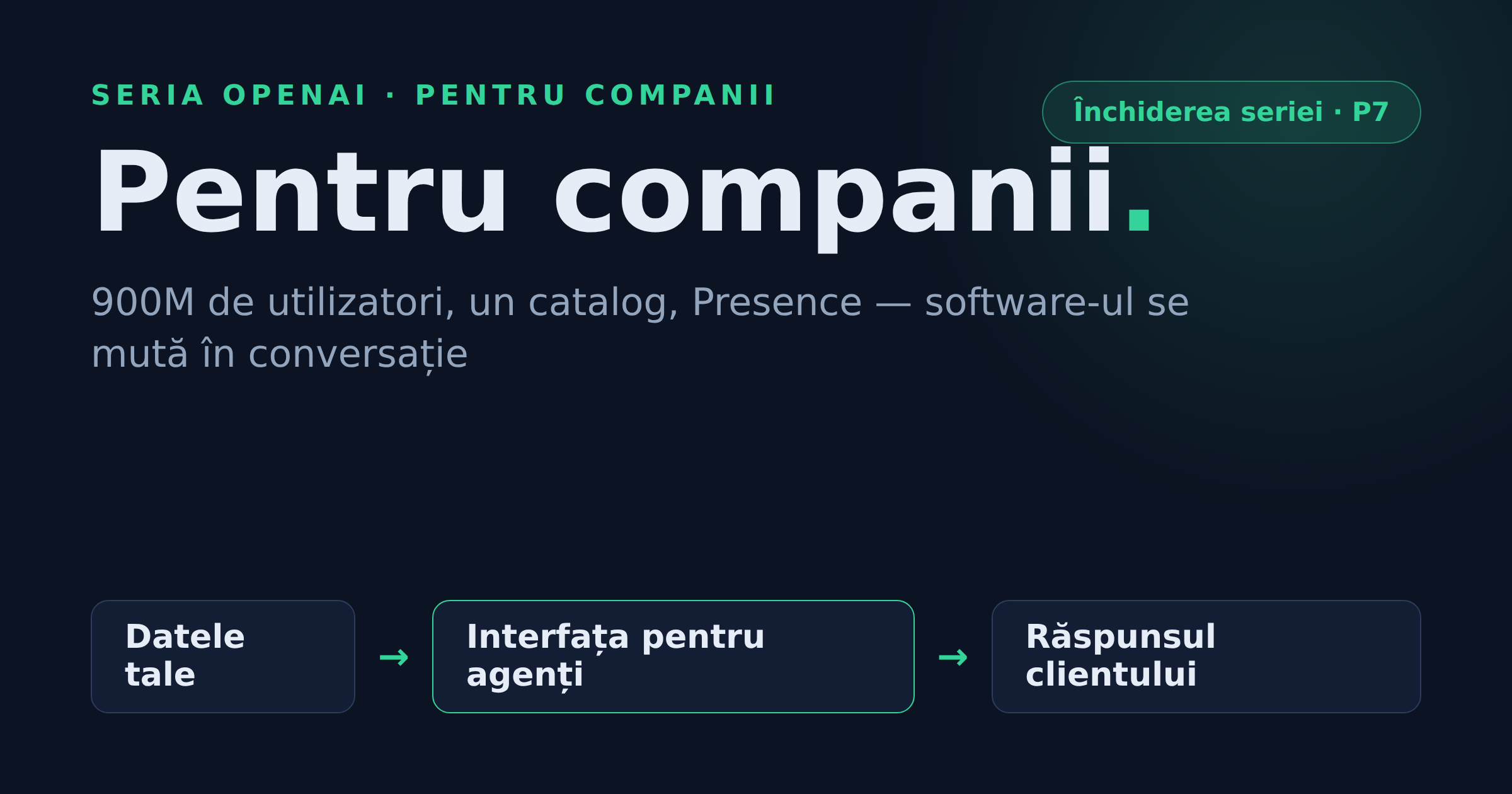
I've closed the case-study series about the four applications I built for the OpenAI ecosystem. This final article changes the perspective: I'm no longer talking about my applications, but about what this exercise means for companies and product teams. Because that's exactly what it was from the beginning: a practical exercise in how AI adoption actually gets done — four different domains, precisely to demonstrate that the method works regardless of industry.
The market that opened next to yours
Numbers first: ChatGPT passed 900 million weekly active users — the figure announced officially by OpenAI. On July 9, OpenAI opened the app catalog — direct distribution to those users. On July 22 it announced Presence, the enterprise platform for voice and chat agents. Consumer and enterprise, one direction: software is moving into the conversation.
For a company, that means an uncomfortable and urgent question: when your customer asks an AI assistant about your product category — will the answer come from your data, or from the model's hallucination? Whoever is present in these ecosystems controls the answer. Whoever isn't gets described from the model's memories. And my opinion, marked as opinion: the other major players will launch their own catalogs and agent platforms. This is not a race with a single finish line.
What four shipped — not presented — applications prove
I've seen plenty of AI strategies that live in slide decks. I chose the opposite path: ship first, write the studies after. What the exercise concretely proves:
- AI adoption is a delivery discipline, not a technology purchase. The same method, repeated four times: a real problem → the capabilities that solve it → the agent interface (MCP) → security → testing through the real flow → publication → review passed. Nothing in that chain is theory; every link is documented and verifiable.
- The domain is not an excuse. Recycling, television, digital safety, travel — if the method works in four unrelated industries, it works in yours.
- The real cost is lower than the market believes — if there is a method. One person, in spare time, with templates and discipline: the first application cost months, the fourth cost days. The right question for a team isn't "can we afford it?" but "why does something take us a quarter that takes a week with a method?".
- Trust is designed, not declared. All four applications refuse, by architecture, to invent: cited sources, verifiable freshness, "we don't know" as a first-class answer. In AI ecosystems, verifiable honesty is the commercial differentiator — users quickly learn whom they can verify.
The questions I would ask my product team
If I ran a P&L and read about the OpenAI catalog, these would be my Monday-morning questions:
- Can our data be read by an AI agent? Not "do we have an API?", but: structured, documented, discoverable, with verifiable freshness?
- If a customer asks an assistant about our product today, what answer do they get? Have you tested it? It's a 5-minute test that scares every single time.
- Which tools would we expose, and what would we name them? The tool description is the new UX — the model chooses by reading it. Who decides that at your company: an engineer in a hurry, or someone who thinks product?
- Where do we honestly say "we don't know"? Masked data gaps become hallucinations with your logo on them.
- What could we publish in an ecosystem in 30 days? Not the 3-year strategy — the first real artifact, with a passed review. The rest is learned by shipping.
The distance between a pilot and a presence
The difference between companies that "explore AI" and those that will matter in these ecosystems isn't budget — it's the discipline of taking one small thing all the way: published, verifiable, used. I wrote about this at length in AI adoption is a delivery discipline: my first application's approval didn't come from a budget, but from a list of requirements treated as definition-of-done. The method is reproducible. I demonstrated it four times, in four industries, and documented every step.
And if you want to see what it looks like in practice, not in theory — the case studies are public, the applications are live, and the first one is installable in ChatGPT right now.
---
With this piece, the "Applications for the OpenAI ecosystem" series is complete: four case studies, the lessons and the implications. It all starts here: What I learned building four applications for the OpenAI ecosystem.