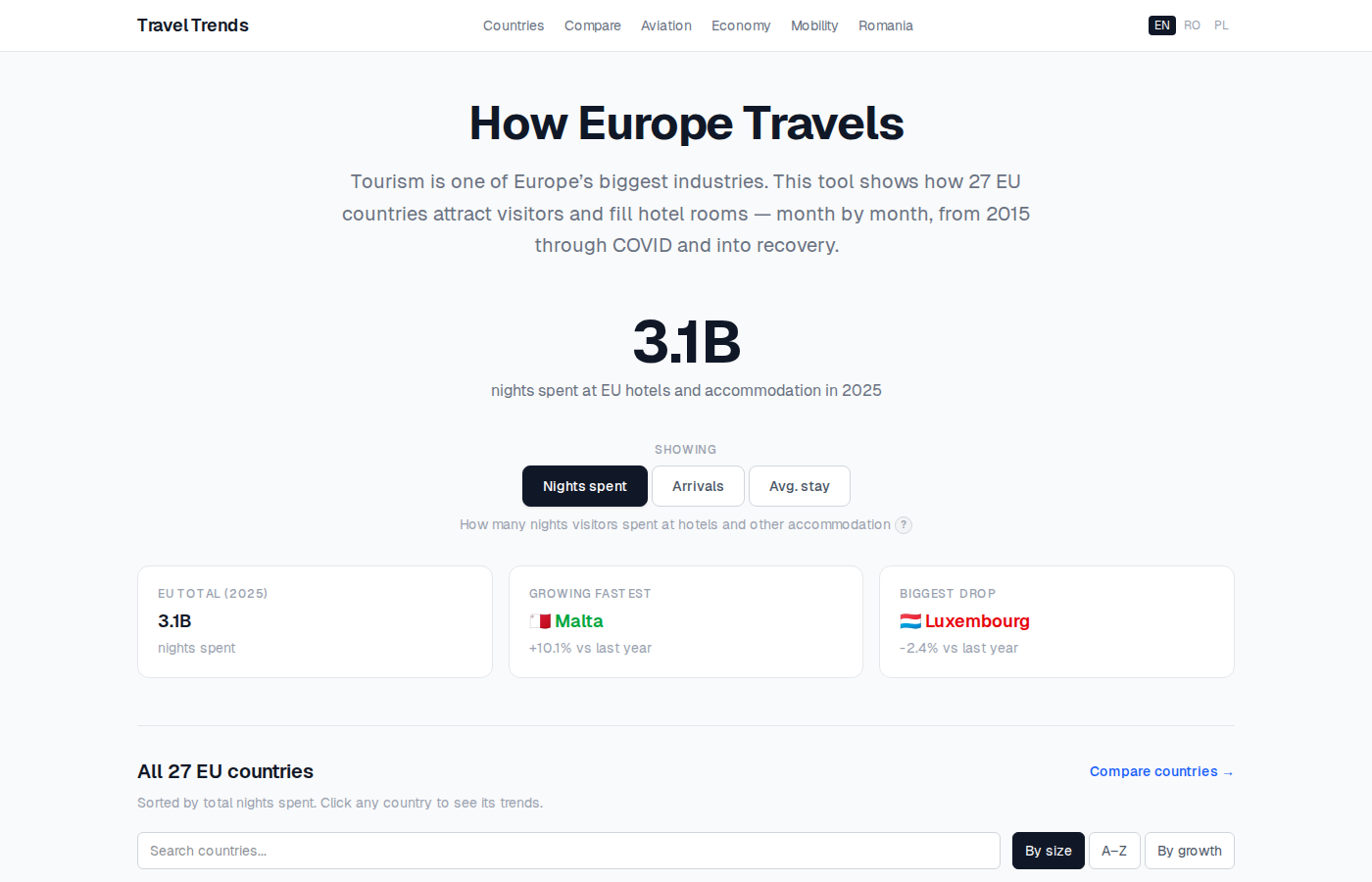
European tourism generates hundreds of billions of euros annually and directly impacts the economies of 27 EU member states. Yet accessing reliable, up-to-date data on tourism trends has always been a challenge for industry professionals. Eurostat data — the main official source — is scattered across dozens of tables, with clunky interfaces and formats that are difficult to interpret quickly.
I built Travel Trends Europe to solve precisely this problem: an interactive platform that transforms raw Eurostat data into clear visualizations and actionable insights.
What Is Travel Trends Europe?

Travel Trends Europe is an interactive European tourism trends explorer built on official Eurostat and INSSE data. The platform covers all 27 EU member states and provides data from January 2015 to the present.
Key features include:
- Centralized dashboard with aggregated European-level metrics: 3.09 billion accommodation nights and 1.08 billion tourist arrivals
- Comparative rankings between countries, updated with the latest available data
- Country-level visualizations with year-over-year analysis and automatic trend identification
- Advanced filtering by time periods, countries, and indicator types
Key Insights from European Data
Analyzing the platform's data reveals significant trends for the travel industry:
Spain Dominates European Tourism
With 513.6 million accommodation nights, Spain remains the undisputed leading destination in Europe. This volume reflects not only natural tourist appeal but also a mature hospitality infrastructure and effective tourism marketing.
Malta — Europe's Surprise Growth Story
Malta records the fastest growth in the EU, with an impressive +10.1% year-over-year. For a small island state, this growth rate indicates an extremely effective tourism strategy and a potential case study for other emerging destinations.
Total European Volume
The 3.09 billion accommodation nights and 1.08 billion arrivals analyzed in the platform provide a complete picture of the European tourism industry's scale. These figures cover January 2015 through February 2026, enabling analysis of the pandemic impact, post-COVID recovery, and current trends.
Technical Implementation
Travel Trends Europe is built with a modern stack optimized for performance and SEO:
- Next.js with App Router for efficient routing and server-side rendering
- React Server Components to minimize JavaScript sent to the client and maximize performance
- Eurostat data consumed through the official API and processed for rapid visualization
- Responsive design adapted for desktop, tablet, and mobile
The choice of React Server Components was deliberate: in an application handling large data volumes, server-side processing significantly reduces load times and improves user experience, especially on mobile devices.
How Can Travel Professionals Use the Platform?
Travel Trends Europe provides value for multiple categories of professionals:
- Corporate travel managers can identify the fastest-growing destinations to anticipate demand
- Travel agencies can use comparative data to adjust their offerings toward growing markets
- Business intelligence analysts gain access to structured data for reports and presentations
- Journalists and researchers can quickly extract updated statistics about European tourism
The platform is freely accessible at travel-trends.mmatinca.eu.
Frequently Asked Questions
What data does Travel Trends Europe use?
The platform uses official data from Eurostat (the statistical office of the European Union) and INSSE (Romania's National Institute of Statistics). Data covers accommodation nights and tourist arrivals across all 27 EU member states, from January 2015 through February 2026.
How often is the data updated?
Data is updated as Eurostat publishes new reports. Typically, data is available with a 2-3 month lag from the reference period, depending on each member state's reporting schedule.
Is Travel Trends Europe free to use?
Yes, the platform is freely accessible at travel-trends.mmatinca.eu. No registration or subscription is required.
What is the most popular tourist destination in Europe?
According to the platform's data, Spain is the undisputed leader with 513.6 million accommodation nights, followed by other major destinations such as France, Italy, and Germany.