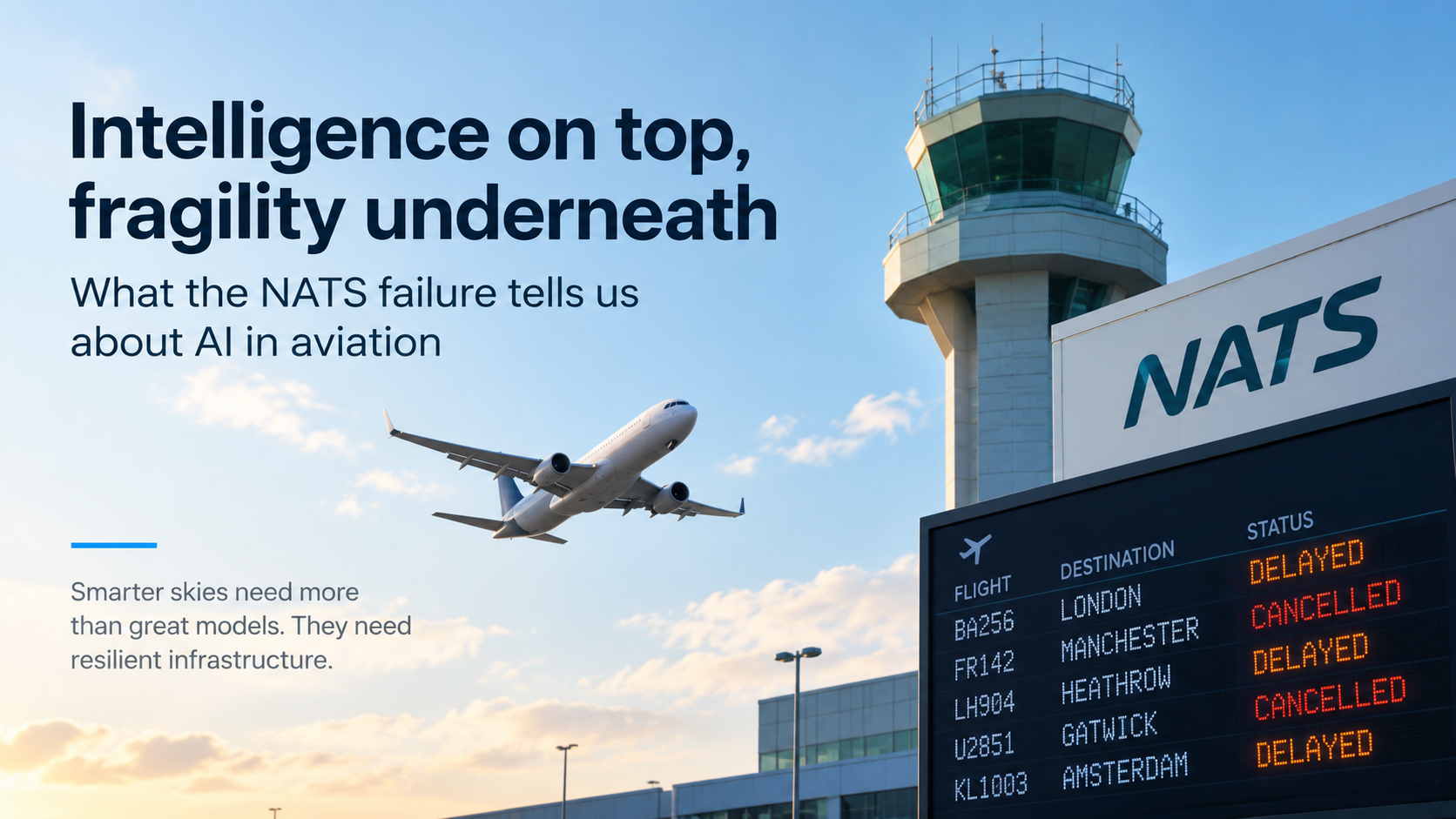
10 September 2026. Figures current as of this date; the NATS internal report is due in about a week and may change the picture.
TL;DR. Three weeks after Google, the Department for Transport and NATS announced an AI programme for the North Atlantic, a fault in NATS' flight-processing system took about three hours to fix and helped cancel more than 2,000 flights. There is no evidence the two are connected, and I explain below why they almost certainly aren't. The story that matters is the third major NATS system failure in just over three years, on a file the regulator had just closed. For anyone who manages business travellers, the lesson is a missing layer in every risk model: critical travel infrastructure.
Critical travel infrastructure is the layer of systems a traveller never sees — the air navigation service provider, its flight-data processing, the European network manager — whose failure propagates through every airline and airport at once, even when nothing at the traveller's own airport or airline has broken.
Three weeks ago, Google, the UK Department for Transport and NATS announced an AI programme to optimise how aircraft cross the North Atlantic. On Tuesday, a fault in NATS' flight-processing system took roughly three hours to fix and, by Wednesday evening, had helped cancel more than 2,000 flights.
There is no evidence the two events are connected. I'll explain below why I think they almost certainly aren't. But the fact that they aren't is exactly what makes the pairing worth writing about.
What actually happened on 8 September?
At 13:46 UK time on 8 September, NATS announced it was investigating an issue in its flight-processing system at Swanwick and restricted departures. A fix was implemented around 16:40 and systems began to recover. [1] [16] The recovery of the network took much longer than the recovery of the system: aircraft and crews were out of position, and airlines kept cancelling into Wednesday. NATS' own statement at 22:10 that evening called it "a very complex recovery" that "has created difficulties for the whole aviation network". [16]
The tally, as of 9 September:
- More than 1,750 flights to and from UK airports cancelled on Tuesday and a further 291 on Wednesday (Cirium). [2]
- Around 330,000 passengers affected, according to the trade body Airlines UK. [2]
- Ryanair alone reported 65,000 passengers disrupted and more than 50 cancellations; British Airways said it had "no choice" but to cancel more than 190 flights. [2]
- Sources differ on the exact count — Flightradar24 tracked around 1,300 cancellations on Tuesday and 347 on Wednesday [3] — so treat "more than 2,000" as an order of magnitude, not a precise figure.
Transport Secretary Heidi Alexander summoned NATS chief executive Martin Rolfe on Wednesday. She told Parliament that she did not believe the outage was caused by a cyberattack, but added that she did not believe it was unavoidable. NATS has one week to report back; the Civil Aviation Authority will run a separate, independent review with a six-month horizon. [4]
NATS says the fault is not the same as the ones behind the 2023 and 2025 outages. [5]
Does Google's Operation Blue Skies have anything to do with it?
On 18 August, a consortium of Google UK, the Met Office, NATS, Contrails.org, Imperial College London and the University of Cambridge launched Operation Blue Skies: a £5 million, 30-month programme, £2.65 million of it from the Department for Transport, to test whether small altitude changes can stop aircraft forming warming contrails across the whole of Shanwick oceanic airspace. [6] Google UK participates pro bono, contributing about £1.4 million in-kind in AI research, engineering time and computing. [7]
NATS is a direct participant: it trials the airspace operations, coordinates air traffic control, does the safety assessment and trains the controllers. [8] So the instinct to ask "was NATS already changing things for Blue Skies when Swanwick fell over?" is a reasonable one. Three facts answer it.
Different place. Blue Skies runs in Shanwick — the eastern half of the North Atlantic corridor. Tuesday's failure hit domestic flight processing at Swanwick and, above all, departures from UK airports.
Different time. The two operational trials are scheduled for the winters of 2026–27 and 2027–28, on selected days. [6] Nothing was operational on 8 September.
Different design. This is the point that settles it for me. NATS has said the altitude adjustments will be delivered through established air traffic control communication channels, so controllers manage participating flights using existing procedures rather than new systems, and that testing will be scheduled in low-traffic periods. [9] Blue Skies was deliberately built not to touch the base infrastructure. The AI produces a forecast; a controller issues a normal clearance; the crew treats it like any other instruction.
That is, incidentally, how you should introduce AI into a safety-critical operation: smallest useful intervention, existing procedures, humans in the loop, easy to switch off. I said as much when the programme launched. The irony is that the layer they were careful not to touch is the layer that failed.
If the NATS report next week mentions a software deployment, a configuration change, a new interface or an integration test, the question reopens. Until then, "Google broke UK air traffic control" is a claim with zero evidence behind it, and I'm not going to pretend otherwise for the sake of a better headline.
The story that matters: three failures, one closed file
The 8 September failure is the third major NATS system incident in just over three years.
August 2023. A flight-plan processing failure over the bank-holiday weekend cancelled around 2,000 flights. The CAA estimated that more than 700,000 passengers were affected and put the cost to industry and passengers at £75–100 million. [10] [11] The regulator commissioned an independent review, chaired by Jeff Halliwell, which called the episode a "major failure" and issued 34 recommendations — 12 for NATS, 11 for the CAA, 6 for airlines and airports, 5 for government — on contingency arrangements, engineering resourcing and earlier notification of disruption. [10] [11]
July 2025. A radar-related fault at Swanwick halted departures for more than four hours and cancelled more than 150 flights. The same transport secretary summoned the same chief executive. [12]
The closed file. On 1 July 2025 the government reported to Parliament that NATS had delivered its recommendations, many already confirmed complete by the CAA, with validation of the remaining NATS items expected that summer and most of the 34 by the end of 2026. [13] Press reports say the CAA closed the last outstanding recommendations on 19 June 2026. [12] [14] Either way: the file on the 2023 failure was, for practical purposes, closed. Tuesday's failure came in the same flight-processing domain as the first.
That sequence — not Google, not AI — is why Ryanair is again calling for Rolfe's resignation and Wizz Air is calling NATS "not fit for purpose". [1] It is also why Alexander's phrase "not unavoidable" is doing a lot of work: it signals that the government will not accept "complex systems fail" as the whole answer.
To be fair to NATS, industry voices have pushed back on the idea that any system can be failure-proof; a former CANSO director general has pointed out that the public accepts daily rail signal faults without demanding resignations. [12] True. But the fallback here is manual flight-plan entry, which cuts throughput to a fraction of normal and makes ground stops inevitable. [14] That is a system that fails safe, and fails hard.
Two lenses I can't switch off
I spend my working life inside two disciplines that both have something to say here.
Business continuity. In ISO 27001 terms, Tuesday was not a security incident; it was an ICT-readiness-for-continuity question. A continuity plan is defined by two numbers: how fast the fallback comes up, and at what capacity. NATS' fallback came up immediately — nobody was ever unsafe — but at a capacity that emptied Heathrow. When the fallback for a peak-season system is "manual, at a fraction of throughput", the plan has been designed for safety, not for service. Both are legitimate objectives. Only one of them is what 330,000 passengers experienced. The question a good auditor asks is not "is there a fallback?" but "what is the real recovery time of the fallback, at what capacity, measured when?".
Six Sigma. Aviation safety operates beyond seven sigma — the certification target for catastrophic failure conditions is on the order of one in a billion flight hours, and Tuesday honoured it: the system failed safe, exactly as designed. Availability of the ground infrastructure lives on a completely different scale, and that is where the three-year pattern bites. In DMAIC terms, the 34 Halliwell recommendations were the Improve phase. Control is the phase where you prove the process stays capable under drift. Three failures with three different mechanisms — a flight-plan edge case, a radar fault, a flight-data fault — is the signature of common-cause variation in a system, not of a defective component you can replace. Fixing each mechanism after the fact is special-cause thinking applied to a common-cause problem. And DPMO misses the point anyway: the defect rate is tiny; the blast radius of each defect is £100 million and two days of network recovery. The metric that matters here is not defects per million opportunities but cost per defect multiplied by how far it propagates.
What does this mean for travel risk?
Here is the practical lesson for anyone who manages business travellers, and for the tool I've been building in my free time, How is my trip? (a travel-disruption radar that runs as an MCP server).
Nothing at your traveller's airport had to break. Nothing at their airline had to break. A layer of infrastructure the traveller has never heard of — the flight-data processing system of an air navigation service provider — degraded for three hours, and the effects propagated through the whole network for two days.
The model most travel-risk tools use looks like this:
trip → destination → weather → geopolitics → transport → alertThe missing layer is critical travel infrastructure:
flight → airline → airport → ATC / ANSP → network (EUROCONTROL) → airspace → cascading disruptionAnd it produces two different signals, which need two different features:
- Day-of signal. "Your flight is still scheduled, but UK ATC capacity is restricted and network disruption is propagating. Risk of delay or cancellation: elevated." This belongs to live trip monitoring, and the natural source is EUROCONTROL's Network Operations Portal, which publishes flow restrictions, congestion and industrial action across the European network.
- Pre-trip signal. "The UK's ANSP has had three major system failures since 2023; the last set of regulator recommendations has been closed." This is a structural-fragility score, and it belongs to the decision a corporate traveller makes seven to ten days before departure: go, change, or cancel.
The first is the feature everyone will now want. The second is the one that actually saves money.
What I'm watching
- The NATS internal report, due around 16 September. The words that matter: deployment, configuration change, new interface, external data feed, migration. Their absence matters just as much.
- The CAA's independent review, due in about six months — and specifically whether it addresses the capacity of the fallback, not just the trigger of the fault.
- Whether the Blue Skies winter trial timetable holds. If NATS slows it down to protect the base layer, that will tell you something about where the real risk sits.
We keep adding intelligence to increasingly connected systems. Intelligence does not replace resilience. The future of aviation isn't only better AI predicting where an aircraft should fly; it's making sure the infrastructure underneath can fail gracefully when something goes wrong.
How is my trip? and the other MCP products mentioned on this site are personal projects built in my free time.
Sources
- AeroTime, "Airlines fume as UK air traffic control failure disrupts nearly 1,000 flights", 8 Sep 2026 — aerotime.aero
- CNN, "Massive disruption hits UK airports after air traffic control issue", 9 Sep 2026 — cnn.com
- The Independent live blog (via NewsBeep), 9 Sep 2026 — newsbeep.com
- Reuters, "UK gives air traffic provider a week to probe outage that halted flights", 9 Sep 2026 — via Yahoo Finance UK
- The UK Pulse, "UK Air Traffic Control Failure Cancels Over 1,000 Flights", 9 Sep 2026 — theukpulse.co.uk
- Aerospace Technology Institute, "Operation Blue Skies Takes Off", 18 Aug 2026 — ati.org.uk
- NATS press release, "Operation Blue Skies Takes Off", 18 Aug 2026 — nats.aero
- Contrails.org, "Operation Blue Skies: Contrail Avoidance at Airspace Scale", Aug 2026 — notebook.contrails.org
- International Airport Review, "In-depth: Operation Blue Skies launches AI trial to reduce aviation contrails", Aug 2026 — internationalairportreview.com
- UK Civil Aviation Authority, "Aviation regulator publishes Independent Review into August 2023 NATS Flight Planning System Failure", 14 Nov 2024 — caa.co.uk
- GOV.UK, written statement, "CAA publication of independent report into NATS technical failure", 14 Nov 2024 — gov.uk
- HNGN, "UK Air Traffic Failure Hits 2,000 Flights; Minister Summons NATS Chief", 9 Sep 2026 — hngn.com
- GOV.UK, written statement, "NATS technical failure of August 2023: CAA progress report on review recommendations", 1 Jul 2025 — gov.uk
- Tech Times, "NATS Grounds Nearly 1,000 Flights in Third Swanwick Failure Since 2023 Reforms", 8 Sep 2026 — techtimes.com
- Google blog, "Operation Blue Skies: Reducing aviation climate impact with AI", 18 Aug 2026 — blog.google
- NATS, "Technical issue updates" (statements of 8–9 Sep 2026, from 13:46 to 12:55 the next day) — nats.aero
Not verified at time of writing and therefore not used: BA's per-flight/per-passenger totals beyond the 190+ cancellations it stated publicly; Heathrow's cancellation count; EUROCONTROL ground-holds of UK-bound aircraft at origin airports; the exact date on which the CAA closed the final Halliwell recommendations (press reports say 19 June 2026; no primary CAA source located).