Most IT budgets are missing their cheapest line item: someone on the client side who understands what the company is buying.
Everything else gets more expensive because of it.
Every organization has vendor contracts. Far fewer have someone who can read a technical estimate and tell you which lines are real and which are padding. The result is predictable:
- Platforms purchased to replace things that already work.
- Diagnostic work quietly pushed back onto the client.
- "Maintenance fees" for systems nobody audits.
- Every new requirement priced as a custom development.
And behind every one of these sits a cost structure most buyers never see in full.
Flexera estimates that around 30% of SaaS spend is waste — features unused, contracts never renegotiated, integrations maintained for flows that never materialized. The number isn't about bad vendors. It's about asymmetry on the buyer side.
Software is never just the license
The price you sign for is one number on a page. The cost is something else entirely.
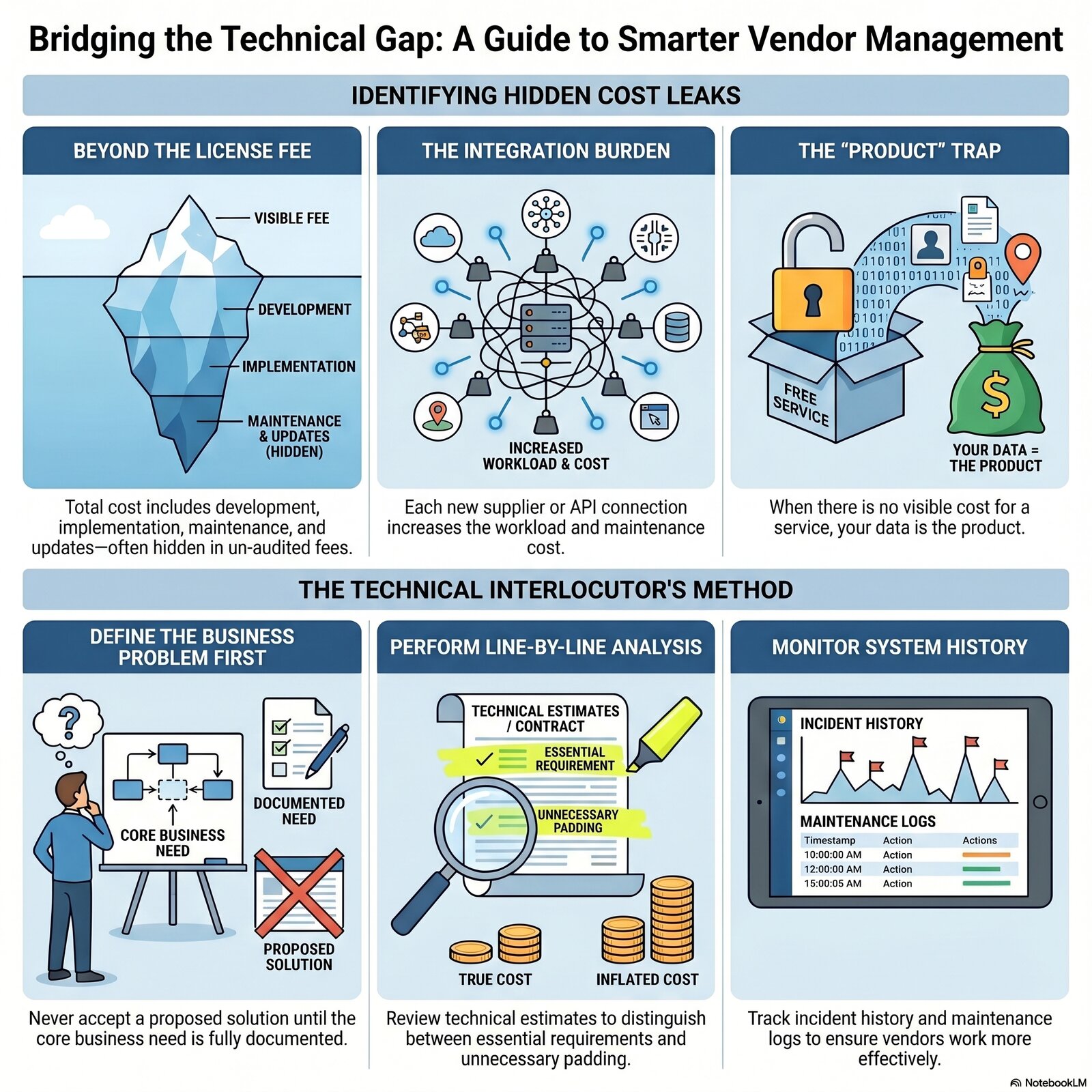
Software is development, implementation, maintenance, updates — and, in almost every contract I've reviewed, every one of those costs is transferred to the client. Sometimes openly, as line items. Sometimes quietly, folded into a "platform fee" or an "annual subscription" that nobody questions.
And where there's no visible cost at all? You are the product.
A concrete example from my industry
Take an online booking tool — the kind every TMC and corporate travel agency uses.
The visible costs are familiar: development, implementation, monthly fee, occasional upgrades.
The invisible one is keeping every API connection alive. Every supplier integration — airlines, hotels, payment providers, fare aggregators — has to be maintained, monitored, and updated every time either side changes something. That work doesn't pause. It compounds.
So when the vendor announces "we've added more suppliers!" — it sounds like more offers and more competitiveness. It also means more connections to keep alive. More workload. More cost.
Order of magnitude: I've seen the same "supplier connection maintenance" line item quoted anywhere from €5K to €60K per year, per integration, for technically identical work. The difference wasn't complexity. It was who was reading the proposal.
Growth of the catalog is growth of the maintenance burden. Someone pays for that. Guess who.
None of this is malicious
It's just what happens when one side of the table understands the product and the other side understands only the invoice.
Vendors aren't villains. They sell what they sell, and they price it for the buyers they actually face. When the buyer can't read a technical proposal, the proposal gets written for someone who can't read it.
A platform replacement is recommended because it's easier to sell than a fix to the existing system. A "custom development" is quoted because the buyer doesn't know the feature is one configuration toggle away. A diagnostic invoice is sent because nobody on the client side knows the logs already contain the answer.
None of this requires bad intent. It only requires asymmetry.
What changes when there's a technical interlocutor on the client side
I've spent years as the single technical interlocutor between a company and its system vendors. The method is boring on purpose:
- Understand the business problem before accepting any proposed solution. Most "platform recommendations" dissolve the moment you ask what problem they're meant to solve.
- Written requirements, not meeting-room consensus. If it isn't in the document, it isn't in the contract.
- Estimates analyzed line by line. Real lines, padded lines, lines that belong in a separate change request — they look the same on a PDF and very different in a conversation.
- Documented incident history. A vendor who knows you remember every incident behaves differently from one who doesn't.
In contracts where this review actually happened, initial prices dropped by 15% to 40%. Not because vendors were lying. Because nobody had ever asked them to justify the lines.
None of this is glamorous. None of it shows up in a productivity report. And none of it is work an IT department can replace with a tool — because the tool is also being sold by a vendor.
The boring sentence that saves the money
Vendors work differently when they know someone on the client side understands what they're buying.
That one sentence has saved more money than any tool I've ever deployed.
It's also the cheapest line item your IT budget is missing.